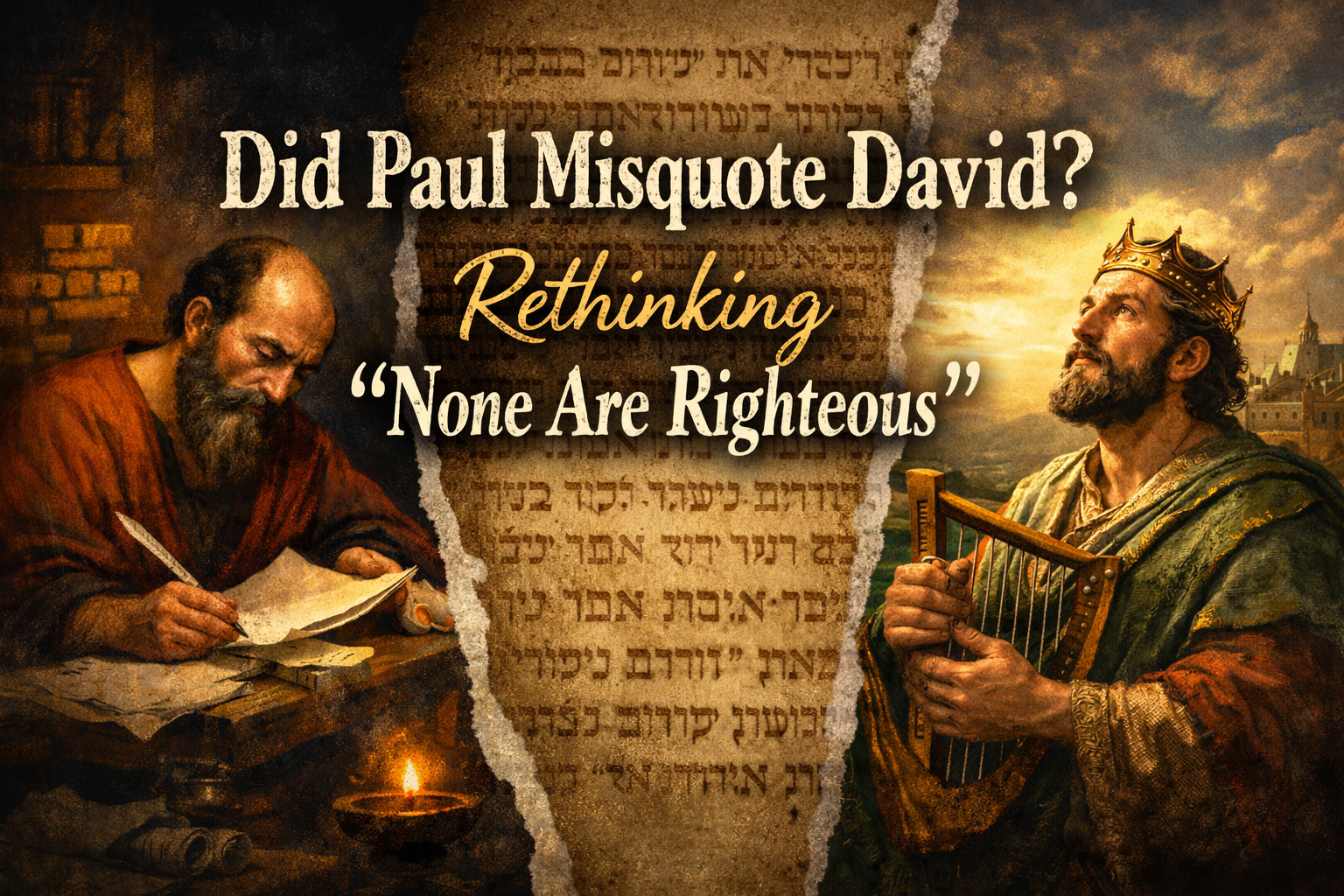
Did Paul Misquote David? Rethinking ‘None Are Righteous
By Steve Eisenhauer, The Exodus Project
Paul’s use of “none are righteous, no, not one” (Romans 3:10) is often treated as a definitive, universal statement about the total moral bankruptcy of all humanity. Within many theological systems, this becomes the foundation for the idea that every person is inherently incapable of righteousness and therefore must rely entirely on an external savior. But when we examine the source Paul is quoting, the Book of Psalms, specifically Psalm 14 and Psalm 53, it becomes clear that this reading is not only stretched, but arguably misapplied.
The psalm opens with a precise subject, “The fool says in his heart, ‘There is no God.’” This is not a blanket statement about all people. It is a targeted critique of a specific type of person, one who denies God and lives without accountability. The verses that follow, “They are corrupt… there is none who does good,” are describing that group. The grammar and flow of the text do not support the idea that David suddenly shifts to condemning every human being universally. In fact, the same psalm explicitly distinguishes “the generation of the righteous,” showing that David clearly believed such people exist.
This creates a direct tension with how the passage is deployed in the Epistle to the Romans. Paul lifts the phrase “none are righteous” out of its immediate context and incorporates it into a larger rhetorical chain aimed at proving that all humanity, Jew and Gentile alike, stands equally condemned. This is not careful exegesis, it is selective quotation for theological effect. By removing the qualifying context, Paul transforms a statement about the corrupt “fool” into a universal anthropology.
That move has consequences. It shifts the message from a warning about moral corruption tied to rejecting God, into a doctrine that denies the meaningful existence of righteousness among people altogether. And that, in turn, creates the theological necessity Paul is driving toward, total dependence on Jesus as the sole source of righteousness. But that necessity is not present in the psalm itself. David never suggests that no one is righteous in an absolute sense, nor that righteousness is unattainable apart from a singular mediating figure. On the contrary, he affirms the existence of a righteous group and presents God as already in relationship with them.
This dynamic is not merely theoretical, it has repeated itself across history. Whenever individuals or systems reject any authority higher than themselves, the result tends toward self-exaltation and moral distortion. From ancient rulers who declared themselves divine, to modern ideological movements that place humanity as the ultimate arbiter of truth and ethics, the pattern is consistent. In many contemporary academic settings, certain forms of atheism elevate human reason or progress to the highest possible standard, effectively replacing God with humanity itself. What begins as the denial of God often ends in the elevation of the self, exactly the kind of “foolishness” David is describing, not merely intellectual error, but a moral posture that removes accountability and justifies corruption.
David’s message is far more grounded and, arguably, more coherent. He is diagnosing what happens when people reject any higher authority, moral decay follows. The “fool” becomes corrupt not simply because of intellectual disbelief, but because that disbelief removes accountability and elevates the self. This is not about abstract metaphysics, it is about lived behavior, injustice, oppression, and ethical breakdown.
Importantly, David does not argue that one must subscribe to a rigid or fully developed theology to avoid this fate. His emphasis is simpler and more universal, recognition that there is something higher than oneself. That acknowledgment establishes humility and moral responsibility. Those who live within that framework are counted among “the righteous,” a category David clearly affirms as real and present.
By contrast, Paul’s framing flattens these distinctions. If no one is righteous at all, then the category itself becomes meaningless apart from his theological system. What David treats as an observable reality, a division between the corrupt and the righteous, Paul recasts into a universal deficiency that only his proposed solution can resolve.
Understanding this difference is critical. The phrase “none are righteous” does not carry a single, fixed meaning across contexts. In Psalm 14, it is a description of the God-denying fool and his moral condition. In Romans 3, it becomes a tool to argue for universal guilt and dependence. Treating Paul’s usage as the definitive interpretation risks obscuring the original message of the psalm and importing conclusions that the text itself does not require.