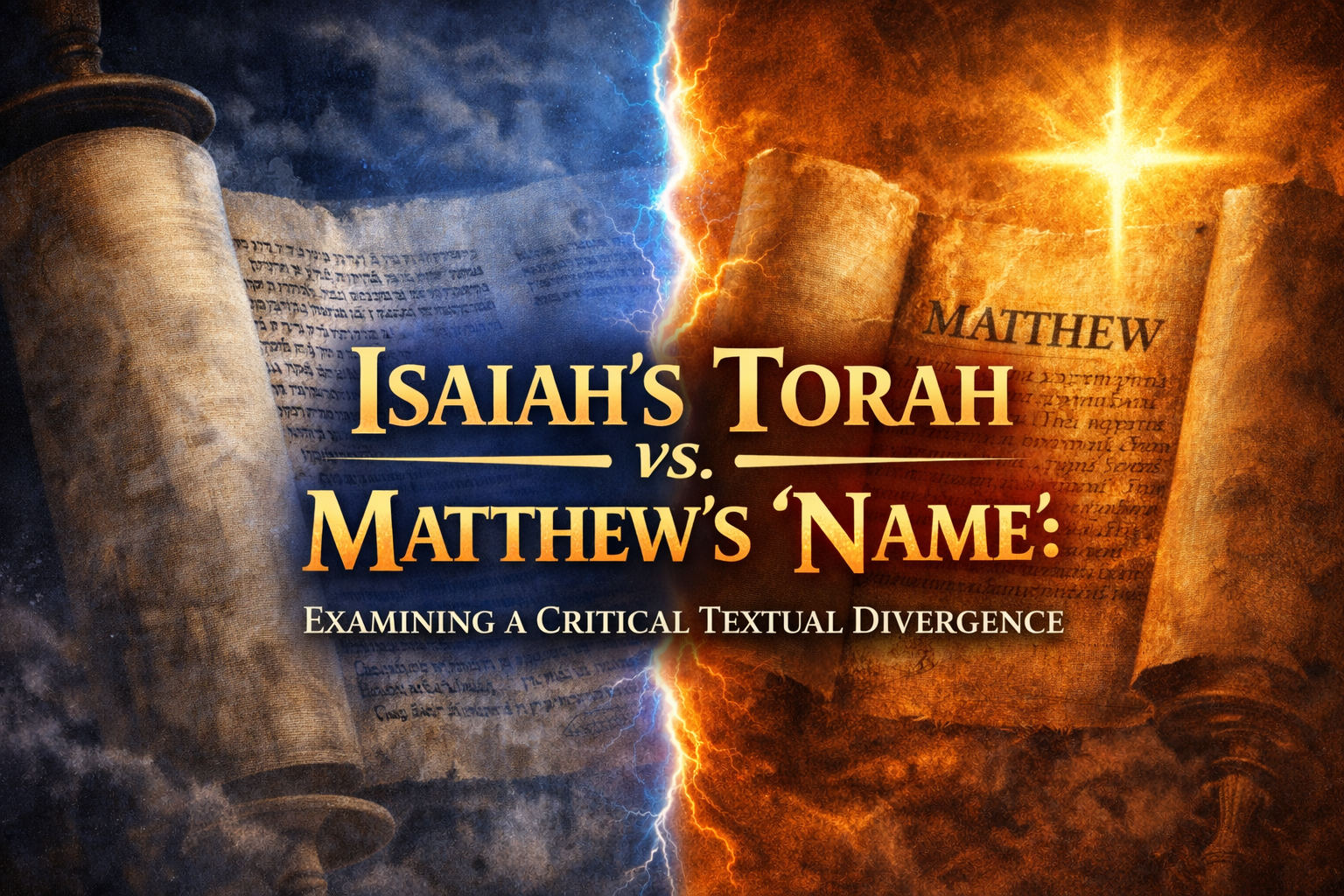
The passage in Matthew 12:18–21 is often presented as a faithful quotation of Isaiah 42:1–4. At first glance, the wording appears closely aligned, reinforcing the common assumption that the Gospel writer is simply quoting the Hebrew prophet to validate his claims about Jesus. However, a closer examination reveals a subtle yet theologically significant shift, one that dramatically alters the meaning of the original text.
Matthew’s version follows the structure of Isaiah 42 quite closely through most of the passage. The servant is upheld, chosen, and endowed with God’s spirit. He brings forth justice, does not cry out or raise his voice, and remains steadfast until justice is established in the earth. Up to this point, the quotation maintains a recognizable continuity with the source material.
The divergence occurs in the final line. Matthew concludes: “and in his name the Gentiles will hope.” This statement carries a distinctly christological emphasis. It centers hope, not in a teaching, system, or covenantal framework, but in the name of a specific individual. The implication is clear: the nations (Gentiles) find their hope exclusively through identification with, or belief in, that individual.
By contrast, the Hebrew text of Isaiah 42 ends quite differently: “and the islands shall wait for his Torah” (וּלְתוֹרָתוֹ אִיִּים יְיַחֵלוּ). The focus here is not on the servant’s name as an object of hope, but on his Torah, his instruction, teaching, or divine law. The nations are not depicted as placing their hope in a person’s identity, but as anticipating and aligning themselves with a body of teaching that brings about justice and order.
This is not a minor linguistic variation, it reflects two fundamentally different theological visions.
In Isaiah, the servant functions as a conduit through which God’s Torah reaches the world. The transformation of the nations comes through the spread and adoption of divine instruction. The emphasis is collective, instructional, and rooted in a covenantal worldview where righteousness is established through adherence to God’s law.
Matthew’s rendering shifts that emphasis toward a more personal, exclusive framework. The servant becomes not merely a teacher or mediator of Torah, but the focal point of hope itself. The nations no longer await instruction, they place their hope in a name. This transforms the role of the servant from one who disseminates divine teaching into one who embodies and replaces it as the central object of faith.
Such a shift aligns with broader themes in the Gospel of Matthew, where Hebrew scriptures are frequently recontextualized to support specific claims about Jesus’ identity and mission. The adaptation of Isaiah 42 serves this purpose by reframing a universal, Torah-centered vision into one that emphasizes personal faith and reliance on a singular figure.
The implications of this change are far-reaching. In Isaiah’s vision, the path to a redeemed world is accessible through the adoption of divine instruction, a model that invites participation through learning and practice. In Matthew’s version, the path is narrowed to faith in a name, introducing a more exclusive mechanism for hope and inclusion.
Ultimately, the difference between “the islands shall wait for his Torah” and “in his name the Gentiles will hope” is not merely stylistic. It represents a profound reinterpretation, one that shifts the axis of redemption from a shared body of teaching to the identity of an individual. Understanding this distinction is essential for anyone seeking to engage honestly with the relationship between the Hebrew Bible and its later interpretations.
A critical follow-up to the discussion of Matthew’s use of Isaiah 42 must address an important textual reality: while Matthew’s wording aligns with the Greek Septuagint (LXX), the broader manuscript and translation tradition overwhelmingly supports a different reading, one that matches the Hebrew text preserved in both the Masoretic tradition and the Dead Sea Scrolls.
Isaiah 42:4 in the Septuagint reads in a way that closely parallels Matthew’s rendering: the nations (Gentiles) are said to “hope in his name.” This provides the textual basis for Matthew 12:21 and explains why his quotation appears, at least superficially, to be legitimate. However, the Septuagint is not the only, nor the earliest, witness to the text of Isaiah.
The Great Isaiah Scroll (1QIsaᵃ), discovered among the Dead Sea Scrolls at Qumran and dated to around the second century BCE, preserves Isaiah 42:4 in Hebrew. Its reading aligns with the later Masoretic Text: “and the islands shall wait for his Torah.” This is not a minor variation in wording, but a fundamentally different conceptual conclusion to the passage. Rather than hoping in a name, the nations are depicted as awaiting divine instruction, the Torah.
This agreement between the Great Isaiah Scroll and the Masoretic Text is significant. It demonstrates that the Torah-centered reading is not a late development, but reflects an ancient and stable Hebrew tradition predating both the rise of Christianity and the composition of the Gospel of Matthew.
Even more compelling is the testimony preserved by Origen. In his Hexapla, Origen compared multiple Greek translations of the Hebrew scriptures, including those of Aquila, Symmachus, and Theodotion. In a surviving note on Isaiah 42:4, he explicitly records that these translators rendered the verse in agreement with the Hebrew: “and in his law the islands will hope” (or wait). This stands in contrast to the Septuagint’s “in his name the nations will hope.”
The image of Origen’s note makes this plain. After citing the Septuagint-like reading, he clarifies that “the Hebrew and the others” read: “and in his law the islands will hope.” This is decisive evidence that multiple independent translation traditions, each known for attempting closer fidelity to the Hebrew text, rejected the Septuagint’s rendering at precisely the point Matthew relies upon.
When the evidence is considered cumulatively, the picture becomes clear. The Septuagint stands alone in presenting the “name” reading. The Hebrew textual tradition, as witnessed by both the Masoretic Text and the much earlier Great Isaiah Scroll, preserves the “Torah” reading. Furthermore, multiple Greek translators working directly from Hebrew sources confirm that the correct sense of the passage centers on law, instruction, and teaching, not on the name of an individual.
This has serious implications for Matthew’s use of the passage. While it is true that he reflects the wording of the Septuagint, the Septuagint itself appears to represent a divergent interpretive tradition rather than the original meaning of Isaiah. Matthew’s argument, therefore, depends on a rendering that is not supported by the strongest textual witnesses.
More importantly, this reinforces the contextual argument about Isaiah 42 as a whole. The servant’s mission is consistently described in terms of bringing forth justice and establishing Torah in the earth. The climax of the passage, in its most reliable form, emphasizes the nations waiting for that Torah. The focus is instructional and universal, not personal and exclusive.
By adopting the Septuagint’s “name” language, Matthew shifts the axis of the text away from Torah and toward a figure whose identity becomes the object of hope. Yet the weight of the textual tradition, Hebrew manuscripts, early scrolls, and multiple Greek revisions, pushes firmly in the opposite direction.
In the end, the issue is not whether Matthew accurately quoted the Septuagint. He did. The issue is whether the Septuagint preserves the original meaning of Isaiah at this crucial point. On that question, the evidence is remarkably one-sided. The Hebrew tradition, supported by the Dead Sea Scrolls and corroborated by multiple ancient translators, consistently affirms that the nations wait for the servant’s Torah.
That reality presents a significant challenge to interpretations that rely on Matthew’s rendering as if it reflects the original intent of Isaiah. Instead, it suggests that what we are seeing is not simple quotation, but reinterpretation, one that stands in tension with the earliest and most reliable witnesses to the text.
The final piece of this discussion brings the full picture into focus, and it is here that the compositional method of Matthew becomes most difficult to ignore. Up to this point, it could be argued that Matthew is simply following the Septuagint where it differs from the Hebrew. But a closer examination of Isaiah 42:1, in comparison with Matthew 12:18, reveals something far more deliberate: Matthew is not consistently following either textual tradition. Instead, he appears to be selectively combining them.
In Isaiah 42:1, the Septuagint explicitly identifies the servant as “Jacob.” The Greek text reads along the lines of: “Jacob is my servant, I will uphold him; Israel is my chosen.” This is a clear interpretive move within the Septuagint tradition, making explicit what is implicit in the broader Isaianic context, that the servant represents Israel collectively.
By contrast, the Hebrew text begins more simply: “Behold my servant, whom I uphold…” It does not explicitly name Jacob or Israel in this verse, allowing the identity of the servant to be understood within the larger literary and thematic framework of Isaiah.
Now, when we turn to Matthew 12:18, something striking happens. Matthew does not follow the Septuagint here. He does not include “Jacob” at all. Instead, he aligns with the Hebrew opening: “Behold my servant…” This omission is significant. By removing “Jacob,” Matthew eliminates the explicit identification of the servant with Israel, thereby opening the door for an individualized interpretation.
However, when we move to the end of the passage, the pattern reverses. Here, Matthew does not follow the Hebrew text, which concludes with the nations waiting for the servant’s Torah. Instead, he adopts the Septuagint’s wording, “in his name the Gentiles will hope,” a rendering that shifts the focus from instruction to personal identity.
This creates a hybrid quotation, one that does not faithfully represent either the Septuagint or the Hebrew text in full. Where the Septuagint would undermine a strictly individual interpretation by naming Jacob, Matthew abandons it in favor of the Hebrew’s ambiguity. Where the Hebrew would emphasize Torah as the object of the nations’ expectation, Matthew abandons it in favor of the Septuagint’s “name” language, which supports a more personalized and exclusive theological claim.
The result is not a neutral citation, but a carefully shaped composition.
This selective alignment strongly suggests intentionality. Matthew preserves what is useful for his christological framework and omits what is not. The identification of the servant with Israel is removed, while the redirection of hope toward a “name” is retained and emphasized. In doing so, the servant is transformed from a collective, Torah-bearing figure into an individual whose identity becomes the focal point of hope for the nations.
This compositional method raises important questions about the nature of Matthew’s use of scripture. Rather than functioning as a straightforward witness to an existing textual tradition, the quotation operates as a theological construction, one that draws from multiple sources but ultimately serves a distinct interpretive agenda.
Seen in light of the evidence from the Hebrew text, the Dead Sea Scrolls, and the alternative Greek translations preserved in Origen’s Hexapla, this hybridization becomes even more pronounced. The broader textual tradition consistently emphasizes Torah as the climactic focus of Isaiah 42:4 and retains, in various ways, the servant’s connection to Israel. Matthew’s rendering diverges from both points, and does so in a way that consistently supports a particular theological outcome.
At this stage, the issue is no longer simply about which textual tradition Matthew followed. The evidence indicates that he did not follow any single tradition consistently. Instead, he appears to have constructed a version of Isaiah 42 that removes elements incompatible with his interpretation and incorporates those that reinforce it.
This is where the tension becomes most acute. The quotation in Matthew 12:18–21 presents itself as fulfillment, as if it were a direct and faithful reflection of Isaiah’s words. Yet when examined closely, it reveals a pattern of selective adaptation. The servant is detached from Israel at the beginning of the passage, and Torah is displaced at the end. What remains is a reconfigured text that centers hope not in divine instruction, but in the identity of a single figure.
In this light, Matthew’s rendering is best understood not as a simple quotation, but as an interpretive synthesis, one that reshapes its source material to advance a specific theological vision. Whether one views this as creative exegesis or something more problematic, the textual evidence makes one point unmistakably clear: the passage in Matthew does not faithfully reproduce either the Hebrew Isaiah or the Septuagint in full, but stands as a constructed bridge between them, designed to lead to a distinctly christological conclusion.