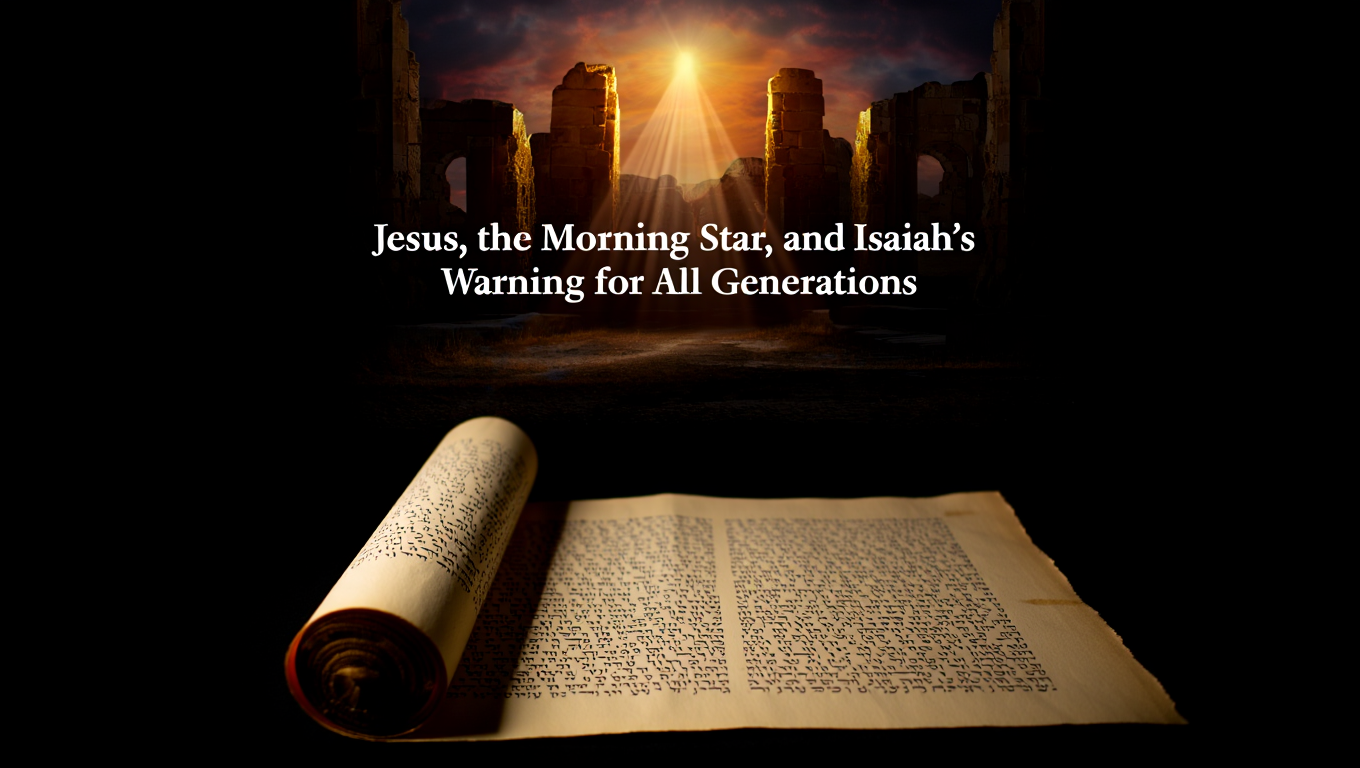
Jesus, the Morning Star, and Isaiah’s warning for all generations
Written By Steve Eisenhauer, The Exodus Project
In the book of Isaiah, chapter 14, the prophet introduces a taunt against the king of Babylon, a figure who represents both a historical ruler and the broader arrogance of empire. The passage opens by framing itself explicitly as a proverb directed at Babylon’s king, describing the fall of an oppressor whose power once seemed unshakable. The language becomes increasingly vivid as it depicts his descent into Sheol, where worms replace royal splendor and the music of court life fades into silence. Then comes the striking image, “How you have fallen from heaven, O morning star, you who ruled the nations.”
The “morning star” in this context refers to the planet Venus, visible brightly before dawn, a fitting metaphor for a ruler who appeared exalted above all others.
Traditionally, in this passage is associated with Nebuchadnezzar, the Babylonian king who destroyed Jerusalem’s First Temple. Whether taken strictly as a reference to him or more broadly as a poetic embodiment of imperial hubris, the point remains the same, a human ruler who exalted himself as if divine is ultimately cast down. Isaiah’s message is not subtle, it is a warning against pride, self-deification, and the illusion of everlasting dominion.
This imagery becomes especially intriguing when compared with later New Testament language. In 2 Peter 1:19, the author speaks of a “morning star” rising in the hearts of believers, presenting it as a symbol of enlightenment and spiritual confirmation. The passage frames this idea within the author’s claimed eyewitness experience of the transfiguration, using that moment as a foundation for authority. Much like Paul the Apostle appeals to visionary experiences to establish his apostolic status, the writer of 2 Peter uses revelation as a means of validating both message and messenger.
Yet the reuse of “morning star” language introduces a tension. In Isaiah, the term is bound to a fallen, prideful ruler brought low for exalting himself. In 2 Peter, it becomes a positive, internalized symbol of divine truth associated with Jesus. Whether this reflects a deliberate reinterpretation or an unexamined borrowing of familiar imagery is open to debate, but the contrast is difficult to ignore.
The theme develops further in the book of Revelation. In chapter 2, within the message to Thyatira, the speaker, presented as Jesus, promises authority over the nations to those who remain faithful, culminating in the statement, “I will give him the morning star.” Here, the symbol again carries connotations of power, rulership, and reward. The faithful are not merely saved, they are elevated, granted dominion, and aligned with this same celestial imagery.
Finally, in Revelation 22:16, the identification becomes explicit. Jesus declares, “I am the root and the descendant of David, the bright morning star.” The symbol is no longer metaphorical or indirect, it is a title claimed outright. The same imagery once used in Isaiah to describe a fallen king is now reappropriated as a mark of authority, identity, and exaltation.
This raises a provocative interpretive question. If Isaiah’s “morning star” represents a ruler who sought divine status and was judged for it, what does it mean for that same title to be embraced in later Christian texts. The New Testament authors appear to invert the symbol, transforming it from a warning into a badge of legitimacy and hope, yet the underlying themes, authority over nations, exaltation, and divine association, remain strikingly similar.
Historically, the trajectory of early Christianity adds another layer to this discussion. Jesus is portrayed in the Gospels as predicting the destruction of the Temple, an event later carried out by the Romans in 70 CE. Ironically, the same Roman Empire that executed him would, within a few centuries, adopt and institutionalize his divinity, culminating in an imperial church structure that mirrored the very systems of power earlier prophetic texts often critiqued.
Seen through this lens, Isaiah 14 can be read not merely as a judgment against an ancient king but as a timeless warning about the recurring pattern of human authority elevating itself to divine status. The New Testament’s use of “morning star” language, whether intentional or not, echoes that same imagery in a dramatically different theological context.
The result is a tension that invites reflection rather than easy resolution. Is the symbol redeemed and transformed, or is it inadvertently repeating the very pattern Isaiah condemned. The answer depends largely on one’s interpretive framework, but the connection itself is unmistakable. Isaiah warned the world about Christianity.