The Burning Bush and Isaiah 53: Israel Through the Fire
By Steve Eisenhauer, The Exodus Project
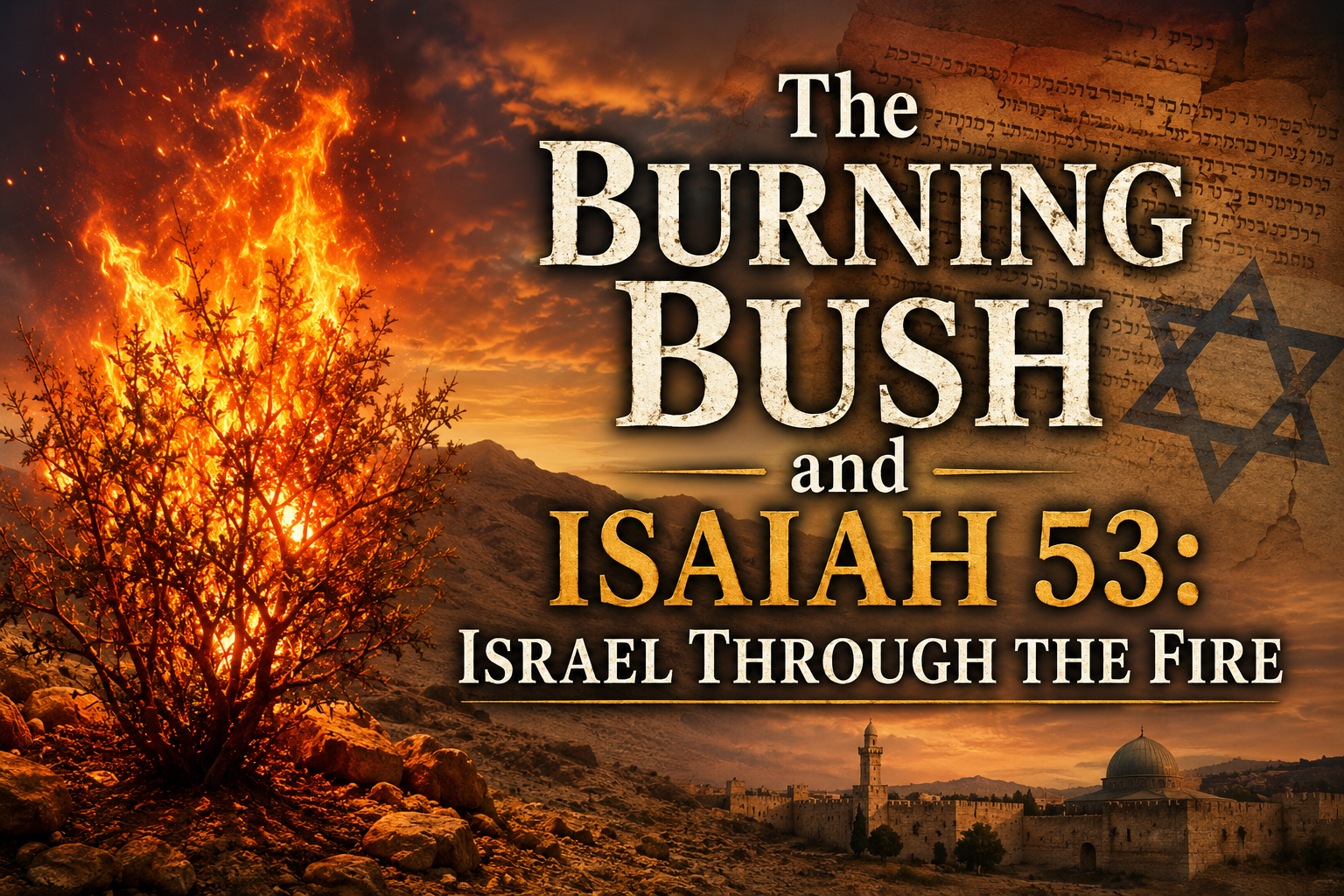
Isaiah’s portrayal of the servant as “a tender plant” and “a root out of dry ground” belongs to a much older prophetic tradition that begins with Moses’ inaugural vision of the burning bush—a lowly desert briar engulfed in flame yet never consumed. From the very moment God reveals Himself to Moses, He chooses not a cedar or oak—the symbols of power used for empires—but the smallest and most fragile of plants. That bush reflects Israel’s identity: a nation that will face fires of affliction and exile, surrounded by destruction, yet miraculously preserved. That opening symbol becomes the lens through which later prophets describe Jewish history.
Isaiah continues this imagery by depicting the servant as a delicate plant growing where it should not grow. A “root out of dry ground” is a plant with no natural expectation of survival. It mirrors the burning bush: something exposed to forces that should annihilate it, yet it remains. In Isaiah’s wider context, the servant is consistently identified as Israel in chapters 41, 42, 43, 44, 49, and 51. Israel is the lowly plant that survives in conditions where natural survival is impossible.
Ezekiel 19 employs the same vocabulary. In his lamentation over Israel’s princes, he describes the nation as a vine uprooted and replanted “in the wilderness, in a dry and thirsty ground.” The vine shrivels, loses strength, and cannot produce a scepter for rulers. This is not a description of an individual but of national exile, mirroring Isaiah’s “dry ground” and Moses’ wilderness bush. The prophetic message is identical: Israel is a vulnerable plant thrust into an environment where it should perish, yet its existence continues by divine will.
This metaphor is not isolated to Isaiah and Ezekiel. Jeremiah uses it explicitly. In Jeremiah 11:16, Israel is first “a green olive tree, fair with goodly fruit,” but foreign nations set it ablaze; still, the tree is not described as destroyed—only damaged. Later, in Jeremiah 17:8, the righteous of Israel are compared to a tree by water that survives heat and drought, an echo of the bush that burns but is not consumed. Israel endures what should kill it.
Hosea adopts similar imagery. In Hosea 14:5–7, God says Israel will again “blossom as the lily” and “strike root as the trees of Lebanon,” a promise of regrowth after devastation. The metaphor assumes the plant was previously scorched or uprooted but will live again—aligning with Isaiah’s root and Ezekiel’s vine.
Amos amplifies this imagery with a national twist. In Amos 2:9, God compares the Amorite to mighty trees—cedars and oaks—yet He destroys them. Israel, by contrast, is elsewhere portrayed as fragile, under pressure, barely surviving—but surviving nonetheless. The mighty trees fall; the small plant lives, just as in Moses’ vision.
Micah also speaks the same symbolic language. In Micah 7:14, Israel is described as a flock that must feed in Bashan and Gilead “as in the days of old,” suggesting restoration after being placed in barren conditions. And Micah 5:7–8 uses agricultural imagery to show Israel scattered like dew among nations, small yet invincible—not consumed by the surrounding world.
Even the Psalms express this theme. Psalm 80 depicts Israel as a vine God brought out of Egypt. It was planted by God, grew, was ravaged by enemies, and yet pleads for restoration—not annihilation. The vine may suffer, but it is never uprooted permanently.
Taken together, all these texts form a tapestry around Moses’ burning bush. The bush is the original declaration that Israel, though small and lowly, will endure fires meant to destroy it. Isaiah’s tender shoot grows from impossibly dry ground. Ezekiel’s vine survives though replanted in a barren wilderness. Jeremiah’s olive tree burns but is not consumed. Hosea’s lily withers but blossoms again. Amos contrasts Israel’s fragility with the fall of mighty trees. Micah shows a scattered remnant that cannot be destroyed. The Psalms affirm Israel as God’s vine surviving hostile forces.
Every one of these prophets, across centuries, preserves the same theological message: Israel is the low plant, the vulnerable vine, the briar in the wasteland—exposed to the flames of empire, exile, persecution, and collapse—but never destroyed. The mighty cedars fall. The kingdoms likened to oaks and firs disappear. But the small, seemingly insignificant plant persists in defiance of nature.
This is why Isaiah 53 must be read nationally, not individually. The metaphor of the suffering plant in hostile soil is explicitly and consistently used for Israel throughout the Tanach. It is never used for a lone redeemer figure. When Isaiah describes the servant this way, he is using the same imagery Moses saw in the burning bush: the symbol of Jewish history itself.
Through fire, exile, and persecution, Israel remains what it was at the beginning—a fragile bush surrounded by flame yet not consumed; a root in dry ground still alive; a vine in the wilderness still standing. The empires, tall as cedars, fall into dust. But the thornbush burns and endures.