By Rod Reuven Bryant, Dir of Eduction, NETIV
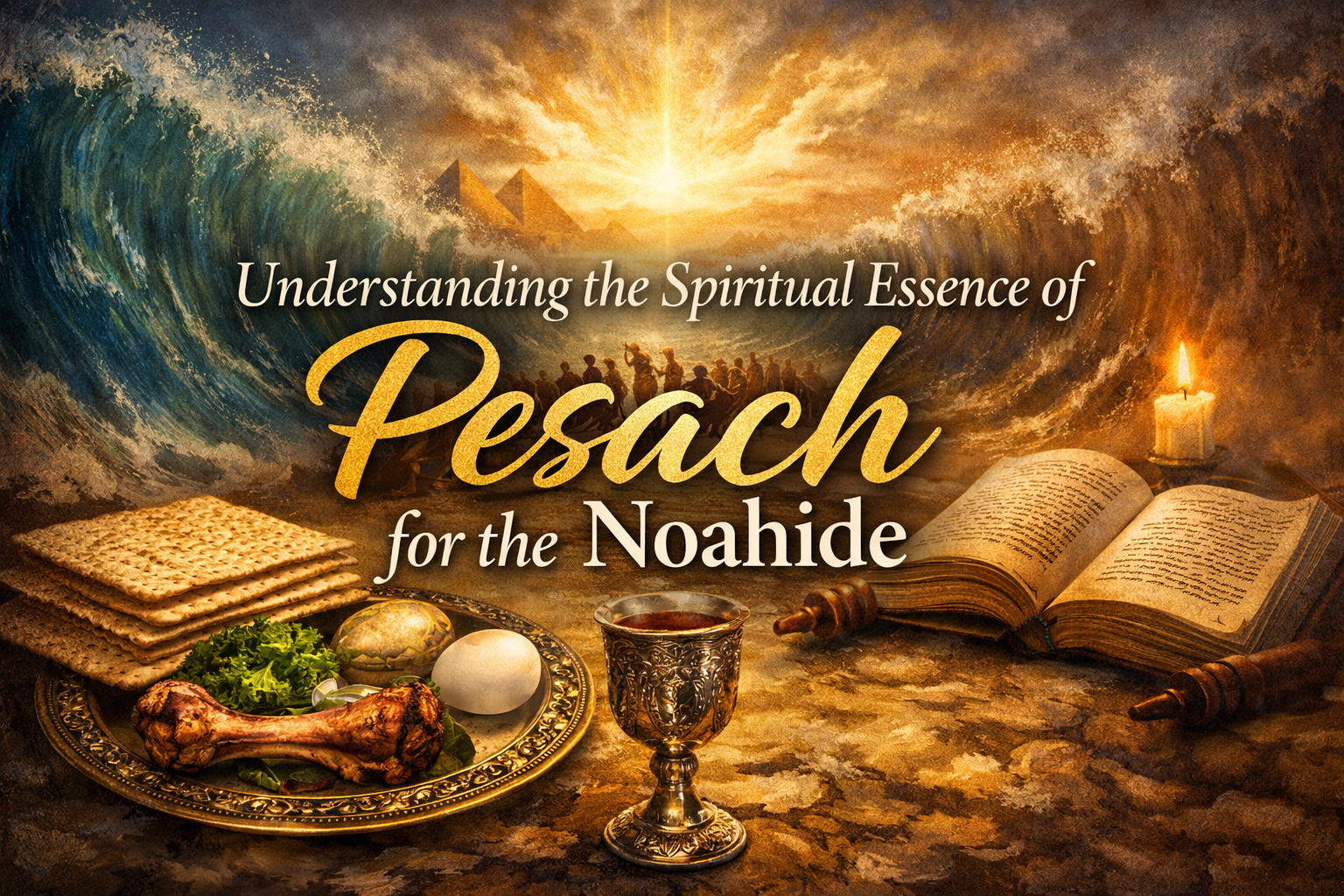
Understanding the Spiritual Essence of Pesach for the Noahide
A Journey from Bondage to Divine Awareness
Every year, as the festival of Pesach approaches, the Jewish people relive one of the most transformative moments in human history—the Exodus from Egypt. But this sacred time is not only for Israel. For the Noahide, Pesach carries a profound and universal spiritual message: the journey from bondage to freedom, from illusion to truth, and from dependency on the material to recognition of the One Creator.
The Universal Message of Freedom
The story of Pesach, recorded in the book of Book of Exodus, is not merely a national liberation narrative. It is a revelation of God’s mastery over nature, history, and human destiny.
As it says:
“And Egypt shall know that I am the Lord…” (Exodus 7:5)
This was not just for Egypt—it was for the entire world.
The great sage Rabbi Moshe Chaim Luzzatto explains in Derech Hashem that the Exodus was a moment when Divine truth became undeniably clear in the world. The hidden hand of God became revealed through open miracles, establishing a foundation of emunah (faith) for all humanity.
For the Noahide, Pesach is a yearly invitation to reconnect with this clarity: to recognize that all power, all systems, and all forces ultimately derive from the One God.
Egypt: More Than a Place
In Hebrew, “Egypt” (Mitzrayim) shares a root with the word meitzarim, meaning “constraints” or “limitations.” The bondage in Egypt represents not only physical slavery but spiritual confinement.
Rabbi Samson Raphael Hirsch writes that Egypt symbolizes a civilization obsessed with material power, denying the Divine source behind existence.
For the Noahide, this is deeply relevant.
We are all born into a kind of “Egypt”—a world that often promotes:
- Self-sufficiency without God
- Material success as ultimate purpose
- Systems that appear independent of the Divine
Pesach calls upon every person to ask:
Where am I still enslaved?
What illusions am I mistaking for independence?
The Birth of Moral Responsibility
One of the most powerful aspects of the Exodus is that it did not just free the Israelites—it introduced the world to the idea of a moral, purposeful relationship with God.
The Talmud teaches:
“In every generation, a person is obligated to see himself as if he personally left Egypt.” (Pesachim 116b)
While this obligation is specifically incumbent upon Jews, the underlying principle is universal.
For the Noahide, this means:
- Seeing oneself as personally leaving behind falsehood
- Accepting the Seven Noahide Laws as a path of Divine service
- Recognizing that true freedom is living aligned with God’s will
The Revelation of God’s Unity
Pesach is also a direct confrontation with idolatry—not only the worship of statues, but the attribution of independent power to anything other than God.
Rabbi Avigdor Miller often emphasized that the plagues were not random punishments, but precise demonstrations that dismantled Egypt’s worldview.
Each plague declared:
- The Nile is not a god
- Nature is not autonomous
- Power does not belong to man
For the Noahide, this is essential. As taught in Nefesh HaChaim by Rabbi Chaim of Volozhin:
“There is no force in the world that operates independently of Him.”
Pesach refines our awareness—removing subtle forms of idolatry from the heart.
Chametz and the Inner Work
One of the central practices of Pesach is the removal of chametz (leaven). On a deeper level, chametz represents arrogance, ego, and spiritual inflation.
For the Noahide, while there is no obligation to remove chametz, the symbolism is powerful:
- Chametz = ego, self-importance
- Matzah = humility, simplicity, truth
The process of “removing chametz” becomes an internal עבודה (service):
Where has ego replaced humility?
Where have I inflated my sense of control?
Joining the Story of Redemption
The prophet Isaiah speaks of a future where all nations will recognize God:
“My house shall be called a house of prayer for all peoples.” (Isaiah 56:7)
Pesach is a preview of that future.
The Exodus was not the end—it was the beginning of a global awakening.
The Midrash Rabbah teaches that when Israel left Egypt, a “mixed multitude” joined them—people from the nations who recognized the truth of God.
Today, Noahides around the world are, in a sense, part of that same movement—awakening to אמת (truth) and aligning with the God of Israel.
Practical Takeaways for the Noahide During Pesach
You don’t need to be Jewish to connect deeply with Pesach. Here are meaningful ways to engage:
- Study the Exodus story (Exodus 1–15) with intention
- Reflect on personal “bondages” and areas of growth
- Strengthen commitment to the Seven Noahide Laws
- Express gratitude for God’s involvement in your life
- Avoid idolatrous thinking in all its subtle forms
Even attending a Seder as a respectful observer can be deeply impactful.
Final Reflection
Pesach is not just about what happened then—it’s about what is happening now.
God is still taking people out of Egypt.
Not always with plagues and miracles, but through awakening, clarity, and truth.
For the Noahide, Pesach is a call:
Leave the narrow places.
Break the inner chains.
Recognize the One.
And in doing so, you step into the deeper purpose for which all humanity was created.