When Heaven Seems Silent: What Moses Teaches the Noahide About Faith, Leadership, and Trust
There are moments in life when a person prays with all their heart — and heaven remains silent.
Many of us know that feeling.
We pray for healing.
We pray for clarity.
We pray for redemption.
We pray for loved ones.
We pray for peace in a chaotic world.
And sometimes the answer does not come the way we hoped.
In Deuteronomy chapter 3, Moses opens his heart in one of the most emotional prayers in the Torah:
“Please let me cross over and see the good land on the other side of the Jordan…”
This is not merely a request to enter a geographical location. It is the cry of a faithful servant who devoted his entire life to a mission he himself would never complete.
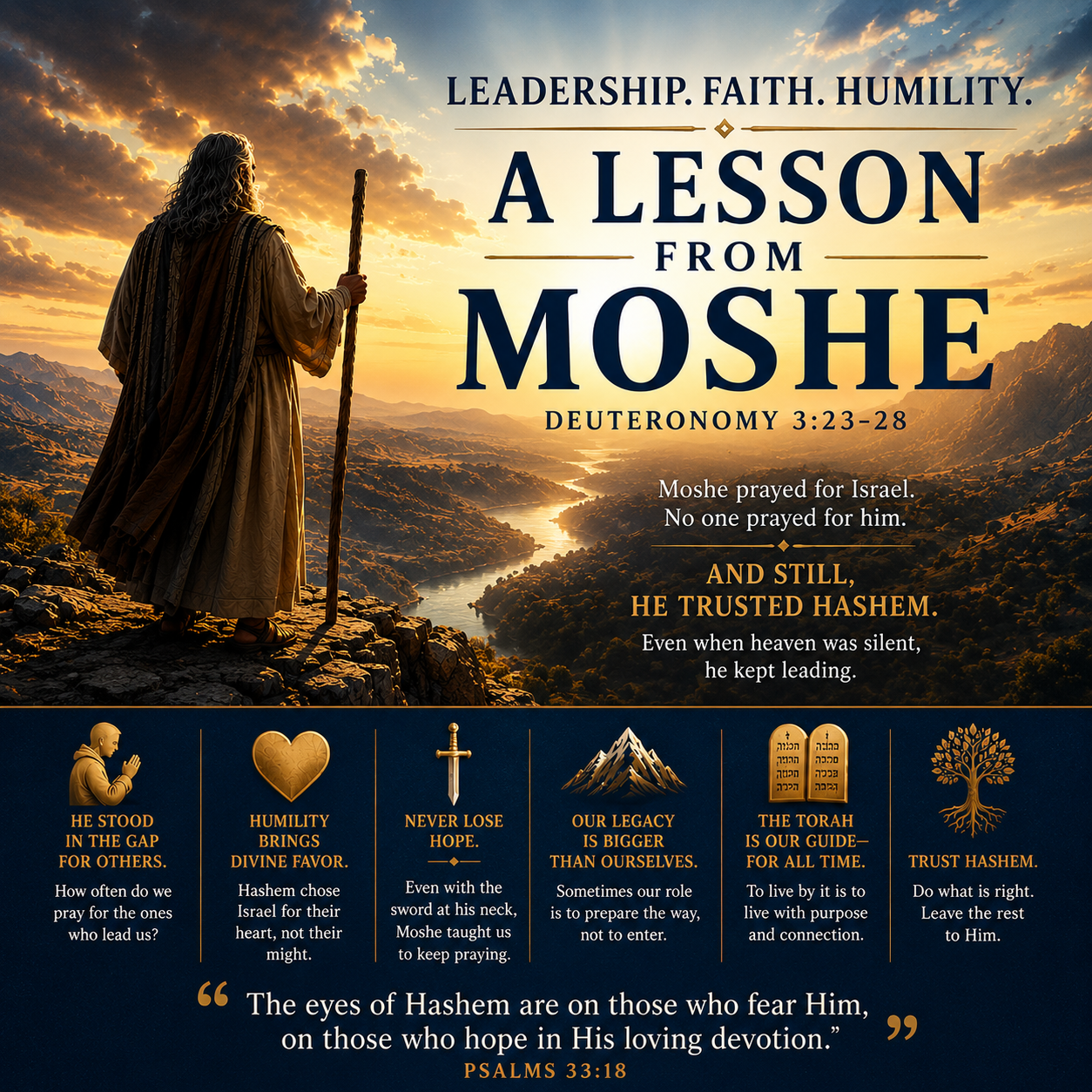
Moses led Israel through slavery, rebellion, fear, war, and wilderness. He stood in the breach repeatedly when divine judgment threatened the people. He pleaded for mercy on behalf of others time and time again.
Yet now, when he himself desired mercy, the decree remained.
The pain of that moment echoes through the generations.
The Loneliness of Leadership
One of the striking ideas brought out in the Midrash is that Moses wondered why the people never prayed for him the way he had prayed for them.
That thought pierces the heart.
How many times had Moses risked everything for Israel?
How many nights did he stand alone carrying burdens no one else understood?
And yet when his own anguish surfaced, few seemed to notice.
This is not merely an ancient story. It is the hidden burden of many leaders, parents, teachers, caregivers, and spiritual guides today.
The people being protected often do not fully understand the cost paid by the protector.
A parent sacrifices quietly.
A leader carries invisible stress.
A righteous person intercedes for others while privately battling exhaustion, disappointment, and loneliness.
Moses teaches us that even the greatest among humanity carried this pain.
And perhaps that realization should awaken compassion within us.
Even With the Sword at Your Neck
The Midrash gives another profound lesson regarding why Moses continued to pray:
Even if a sharp sword rests upon a person’s neck, he should never despair of mercy.
What a message for our generation.
We live in turbulent times. Nations rage. Fear spreads rapidly. Society feels unstable. Many people feel spiritually exhausted and emotionally overwhelmed.
There are moments when it feels as though the knife is already at the throat of humanity.
Yet Moses teaches us something eternal:
Never surrender hope.
Not because circumstances look favorable.
Not because the world feels stable.
But because God remains faithful even when human strength fails.
Faith is not denial of difficulty.
Faith is refusing to abandon trust in the middle of difficulty.
For the Noahide seeking truth and righteousness in a confused world, this lesson is essential. We may not always understand God’s timing, but we are never abandoned by Him.
Trusting God Beyond Comfort
One statement shared during the discussion carried enormous weight.
A Noahide man responded to criticism about his faith by saying:
“The God of Abraham, Isaac, and Jacob is my God, and if He sends me through suffering, I will trust that it is ultimately for my good.”
That level of trust is difficult.
Perhaps frightening.
But genuine faith has always required surrender.
Not passive surrender.
Not weakness.
But confidence that God’s wisdom exceeds our own understanding.
Moses himself embodied this trust. Even after being denied entry into the Land, he continued guiding, teaching, blessing, and strengthening the people.
He did not allow disappointment to poison his mission.
That alone is a lesson worth meditating on.
Humility: The Secret of Greatness
Toward the end of the discussion, attention turned to a remarkable teaching about why God chose Israel:
Not because they were numerous.
Not because they were mighty.
Not because they were powerful.
But because of humility.
Abraham said:
“I am but dust and ashes.”
Moses said:
“What are we?”
True greatness in Torah is not arrogance. It is humility before Heaven.
The world often celebrates self-exaltation, ego, and domination. Torah points us in another direction entirely.
Humility does not mean weakness.
It means recognizing that every gift, every breath, every opportunity comes from God.
For Noahides walking a path of righteousness, this matters deeply. Spiritual maturity is not measured by titles, certificates, or public recognition. It is measured by integrity, justice, compassion, humility, and faithfulness.
As was passionately expressed during the class:
You do not need a certificate to validate what God already created you to be.
A righteous human being is recognized by the way they live.
The Sabbath and the Destiny of Humanity
An important discussion also emerged regarding Shabbat and the role of the nations.
The deeper message was not merely about legal boundaries, but about remembering Creation itself.
The Sabbath stands as a testimony that the universe is not random.
Humanity is not accidental.
Life has purpose.
The Noahide calling is not to imitate every covenantal obligation given specifically to Israel, but to recognize the holiness embedded in creation and live in conscious relationship with the Creator.
The Sabbath reminds humanity that history is moving somewhere.
Toward redemption.
Toward restoration.
Toward the knowledge of God filling the earth.
Moses Never Entered — Yet He Still Led
Perhaps the most moving realization from the entire discussion is this:
Moses did not stop serving simply because he was disappointed.
He strengthened Joshua.
He prepared the people.
He taught until the very end.
Even outside the Land, he sanctified the Name of God.
There is a profound lesson here for every Noahide.
You may not yet see the fulfillment of every prayer.
You may not yet stand in the “promised land” of your hopes.
Some prayers may still feel unanswered.But your mission still matters.
Your kindness matters.
Your faithfulness matters.
Your pursuit of truth matters.
Your refusal to abandon God matters.
And perhaps most importantly:
Your trust in God during uncertainty matters more than you realize.
Like Moses, we continue walking forward.
Like Moses, we continue teaching.
Like Moses, we continue believing.
And in doing so, we help bring light into a very dark world.
Shalom. Rod