The Four Battles Within the Human Heart
By M. Simpson
Reflections on Pirkei Avot 5:10
One of the great gifts of Pirkei Avot is that it refuses to let us reduce righteousness to theology alone. Belief matters, but character determines whether those beliefs become a blessing or a curse.
In one deceptively simple teaching, the Sages present four types of human character—not as four kinds of people, but as four voices that exist within every one of us.
The Mishnah teaches:
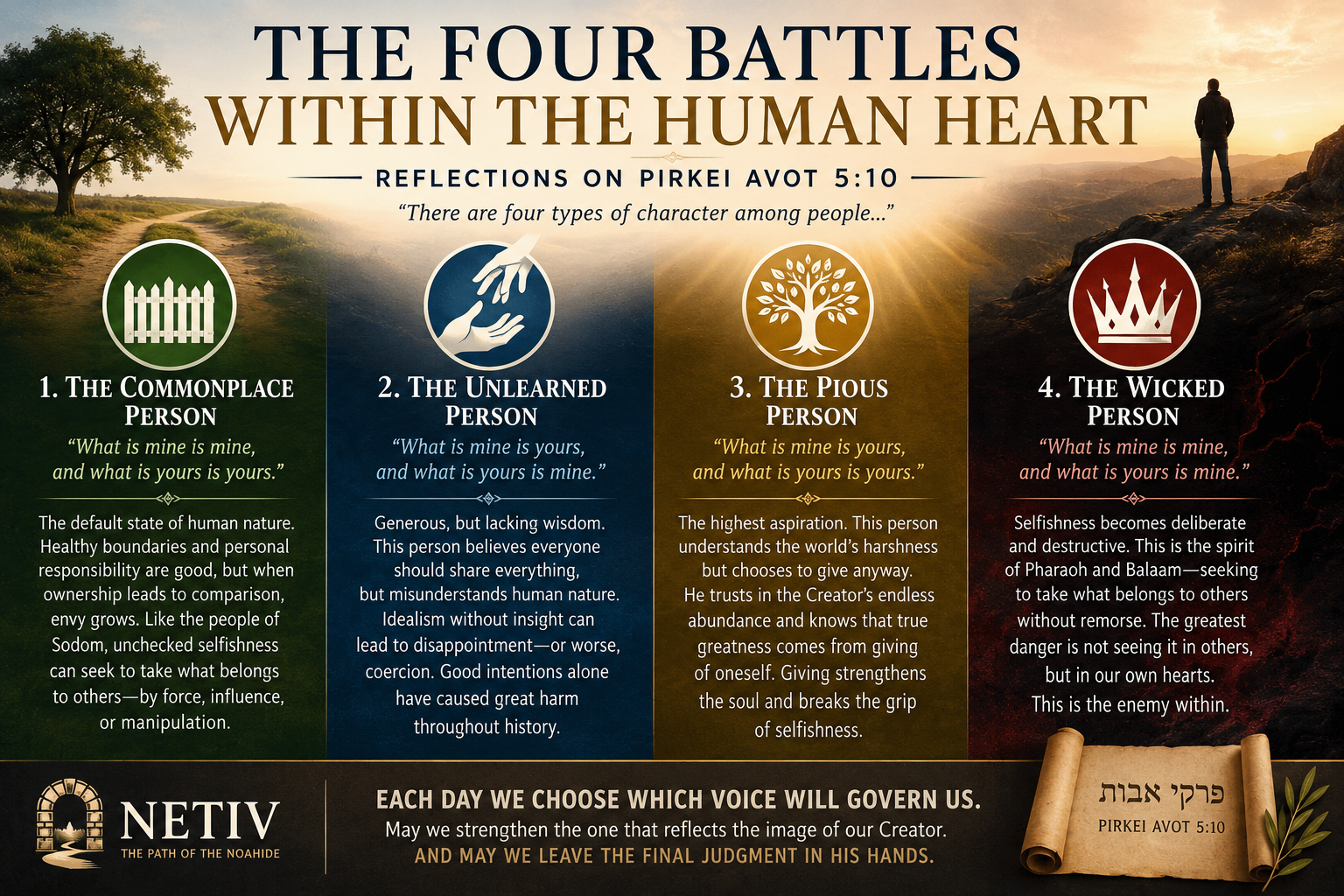
There are four types of character among people:
“What is mine is mine, and what is yours is yours”—this is the commonplace type. Some say this is the character of Sodom.
“What is mine is yours, and what is yours is mine”—this is the unlearned person.
“What is mine is yours, and what is yours is yours”—this is the pious person.
“What is mine is mine, and what is yours is mine”—this is the wicked person.
At first glance, these seem like simple descriptions of generosity and selfishness. But beneath them lies an entire map of the human soul.
1. The Commonplace Person
“What is mine is mine, and what is yours is yours.”
This is the default setting of humanity.
We are born with a natural instinct for self-preservation. We protect what belongs to us. We build fences around our lives. In many ways, this is necessary. Ownership, responsibility, and personal stewardship are good things.
Modern Western culture often elevates this attitude into its highest definition of freedom:
“I’ll take care of mine, and you take care of yours.”
There is wisdom in personal responsibility.
But the Sages issue a warning.
Some say this attitude resembles the people of Sodom.
Why?
Because when human beings become disconnected from generosity, ownership slowly transforms into comparison.
Why does he have more than I do?
Why not me?
Comparison becomes envy.
Envy becomes resentment.
Resentment eventually seeks power.
The desire to possess what belongs to another can wear many disguises. Sometimes it appears through force. Sometimes through manipulation. Sometimes through social pressure. Sometimes through law.
The problem is not ownership.
The problem is a heart that has forgotten gratitude.
Like the yetzer hara—the evil inclination—self-interest is not evil in itself. Properly directed, it builds families, businesses, and civilization itself. Left unchecked, however, it is never satisfied.
The appetite only grows.
2. The Unlearned Person
“What is mine is yours, and what is yours is mine.”
At first this sounds wonderfully generous.
But the Sages call this person unlearned.
Why?
Because generosity without wisdom is not yet holiness.
Children often believe everyone should simply share everything. It is a beautiful instinct, but it does not yet understand human nature.
A father smiles when his child comes home hungry because he gave away his lunch to someone who “needed it.”
The child is not wicked.
He is simply inexperienced.
To say:
“What is mine is yours.”
is an act of kindness.
But to assume:
“What is yours is mine.”
is something entirely different.
It quietly assumes ownership over another person’s labor, sacrifice, and stewardship.
This mindset often believes humanity is naturally selfless.
Experience teaches otherwise.
The heart must be trained toward generosity because selfishness comes naturally.
Without wisdom, idealism can become coercion.
History repeatedly reminds us that some of humanity’s greatest tragedies began with people convinced they were creating a more equal world.
Good intentions alone are never enough.
3. The Pious Person
“What is mine is yours, and what is yours is yours.”
Here we encounter the highest aspiration.
The pious person is not naïve.
He understands exactly how broken the world can be.
He knows people may exploit his kindness.
He knows generosity is often misunderstood.
He gives anyway.
Why?
Because his confidence no longer rests in what he possesses.
It rests in the One who gave it.
The chasid understands a profound spiritual truth:
The Creator’s abundance is not diminished by our generosity.
Every act of giving loosens the grip of selfishness upon the soul.
He says,
“Of course what belongs to you remains yours.
And if what belongs to me can become a blessing for someone else, then let it serve its purpose.”
This is not weakness.
It is freedom.
The pious person has discovered that life is not ultimately divided between rich and poor, powerful and powerless, successful and unsuccessful.
The deeper division is between those who give and those who cannot.
Giving becomes the language of Heaven.
The soul was created to resemble its Creator.
Since God is the ultimate Giver, we become most like Him when we learn to give ourselves away—not recklessly, but willingly.
Every generous act strengthens the chains that restrain the evil inclination.
Every sacrifice enlarges the soul.
4. The Wicked Person
“What is mine is mine, and what is yours is mine.”
This is the final corruption of character.
Here selfishness becomes deliberate.
The wicked person understands how the world works and chooses exploitation anyway.
He refuses merely to preserve what is his.
He seeks to consume what belongs to everyone else.
Throughout Scripture we encounter this spirit in many forms.
It is Pharaoh’s hardened heart.
It is Balaam’s corrupted vision.
It is every tyrant who believes other human beings exist merely as tools for his own advancement.
But the greatest danger is not recognizing this spirit in others.
It is recognizing it in ourselves.
Every one of us knows the temptation.
“I’ve worked hard.”
“I deserve more.”
“I refuse to be taken advantage of.”
Little by little the soul begins measuring life by accumulation instead of contribution.
The object changes.
Money.
Status.
Influence.
Recognition.
Power.
Possessions.
But the disease remains the same.
The human heart slowly becomes incapable of gratitude because it has become consumed by acquisition.
The Battle Before Gog and Magog
The prophets speak of a great battle at the end of history.
Before that battle ever arrives upon the earth, another battle takes place every morning inside the human heart.
Each day we choose which voice will govern us.
The commonplace voice.
The naïve voice.
The generous voice.
Or the wicked voice.
None of us permanently belongs to only one category.
There are moments when we are selfish.
Moments when we are naïve.
Moments when we are generous.
Moments when we are tempted to exploit others.
The wisdom of Pirkei Avot is not that it labels people.
It reveals the battlefield.
The Noahide Calling
For those of us seeking to walk with the God of Israel as faithful descendants of Noah, this teaching carries profound significance.
The goal is not merely to obey commandments.
It is to become the kind of people those commandments were designed to produce.
Our task is to move steadily away from the gravity of self and toward the light of the Creator.
To become people whose first instinct is gratitude rather than comparison.
Service rather than entitlement.
Giving rather than taking.
May we learn to recognize each of these four voices within ourselves.
May we strengthen the one that reflects the image of our Creator.
And may we leave the final judgment—as always—in His hands.