Acts 15 and the Noahide Framework: Rediscovering the Shared Ethical Covenant
What did the Jerusalem Council actually decide in Acts 15? Was it creating a new religion, or was it reaffirming an ancient biblical framework that had existed since the days of Noah?
These questions sit at the heart of one of the most important discussions in biblical history. In our latest podcast, we explore the fascinating connection between Acts 15 and the Seven Laws of Noah—an ethical covenant that Jewish tradition has long understood to be binding upon all humanity.
Watch the Podcast
The Gentile Dilemma
As the message of the God of Israel spread throughout the Roman world, thousands of Gentiles began turning away from idolatry and embracing the God of Abraham, Isaac, and Jacob.
This created a major theological challenge:
Must Gentiles become Jews in order to serve the God of Israel?
Some believers argued that circumcision and full conversion were required. Others believed that God had provided a distinct path for the nations.
The debate became so significant that it was brought before the Jerusalem Council in Acts 15.
The Decision of the Jerusalem Council
After hearing testimony from Paul, Barnabas, and Peter, the council reached a conclusion that would shape history.
Rather than requiring Gentiles to convert to Judaism, the council instructed them to observe several foundational prohibitions:
- Abstain from idolatry
- Abstain from sexual immorality
- Abstain from blood
- Abstain from things strangled
At first glance, these requirements may appear arbitrary. However, when viewed through the lens of Jewish tradition, they reveal something remarkable.
These principles closely parallel the ethical obligations traditionally associated with the descendants of Noah.
The Ancient Covenant of Noah
According to Jewish tradition, all humanity stands within a universal covenant established after the Flood.
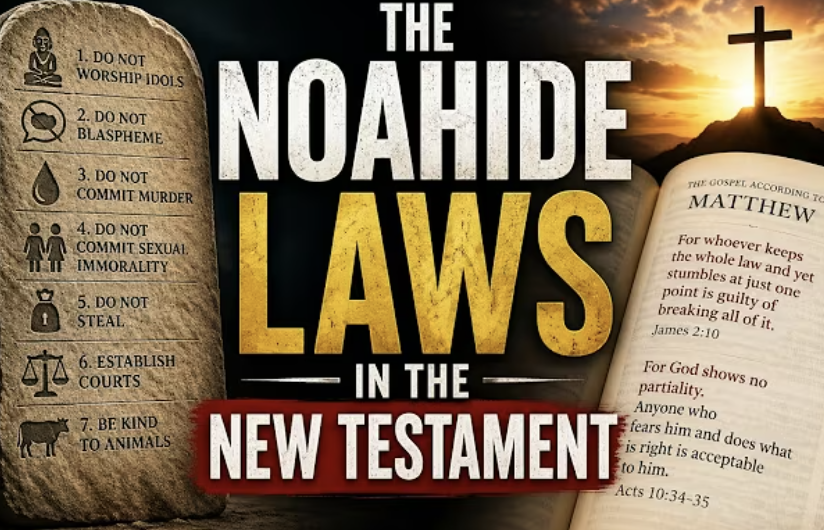
This covenant is commonly expressed through the Seven Laws of Noah (Sheva Mitzvot Bnei Noach):
- Prohibition of idolatry
- Prohibition of blasphemy
- Prohibition of murder
- Prohibition of sexual immorality
- Prohibition of theft
- Prohibition of eating flesh taken from a living animal
- Establishment of courts and justice
These commandments form a universal ethical framework for civilization and righteous living.
Rather than creating a new path, the Jerusalem Council appears to have recognized a path that already existed.
Acts 15 Through a Jewish Lens
When examined in its first-century Jewish context, Acts 15 becomes much easier to understand.
The council was not debating whether Gentiles could serve God.
The real question was:
How should Gentiles enter into a covenantal relationship with the God of Israel without becoming Jewish?
The answer given by the council reflects a pattern already known within Jewish thought:
Gentiles were not required to become Israelites. They were invited to serve God faithfully within their own covenantal obligations.
This perspective helps explain why the council did not mandate circumcision, dietary laws, or full Torah observance for the nations.
Two Distinct Paths, One God
One of the most beautiful insights from this discussion is the recognition that Scripture presents different covenantal responsibilities for different peoples.
Israel’s Covenant
The Jewish people were entrusted with the Torah at Sinai and called to be a “kingdom of priests and a holy nation.”
Humanity’s Covenant
The nations were entrusted with the covenant of Noah, a universal moral framework that applies to all people.
These are not competing covenants.
They are complementary expressions of God’s plan for humanity.
Why This Matters Today
Many people today are rediscovering the Noahide path as a meaningful way to connect with the God of Israel while remaining faithful to their own identity among the nations.
For some, this discovery resolves long-standing theological questions:
- Is conversion necessary to draw close to God?
- What obligations does Scripture place upon non-Jews?
- How did the earliest followers of the God of Israel understand the role of the nations?
Acts 15 offers a powerful glimpse into how these questions were addressed in the first century.
A Shared Ethical Future
The Noahide framework is not merely about prohibitions. It is about building a just, moral, and God-centered world.
The prophets envisioned a future in which all nations would recognize the Creator and walk in His ways.
The covenant of Noah provides a foundation for that vision—a universal ethical system capable of uniting humanity while preserving the unique mission of Israel.
The Jerusalem Council’s decision may therefore be seen not as a departure from Jewish thought, but as an affirmation of an ancient truth:
All humanity can draw near to God, each according to the covenant entrusted to them.
Continue the Conversation
What do you think?
Does Acts 15 reflect the Noahide framework? How should modern readers understand the relationship between the covenant of Israel and the covenant of Noah?
Share your thoughts in the comments below.
Learn More
For more teachings on Noahide living, Torah wisdom, and the relationship between Israel and the nations, visit:
And be sure to subscribe to our YouTube channel for future podcasts, classes, and discussions on biblical faith and the Noahide path.