בס”ד
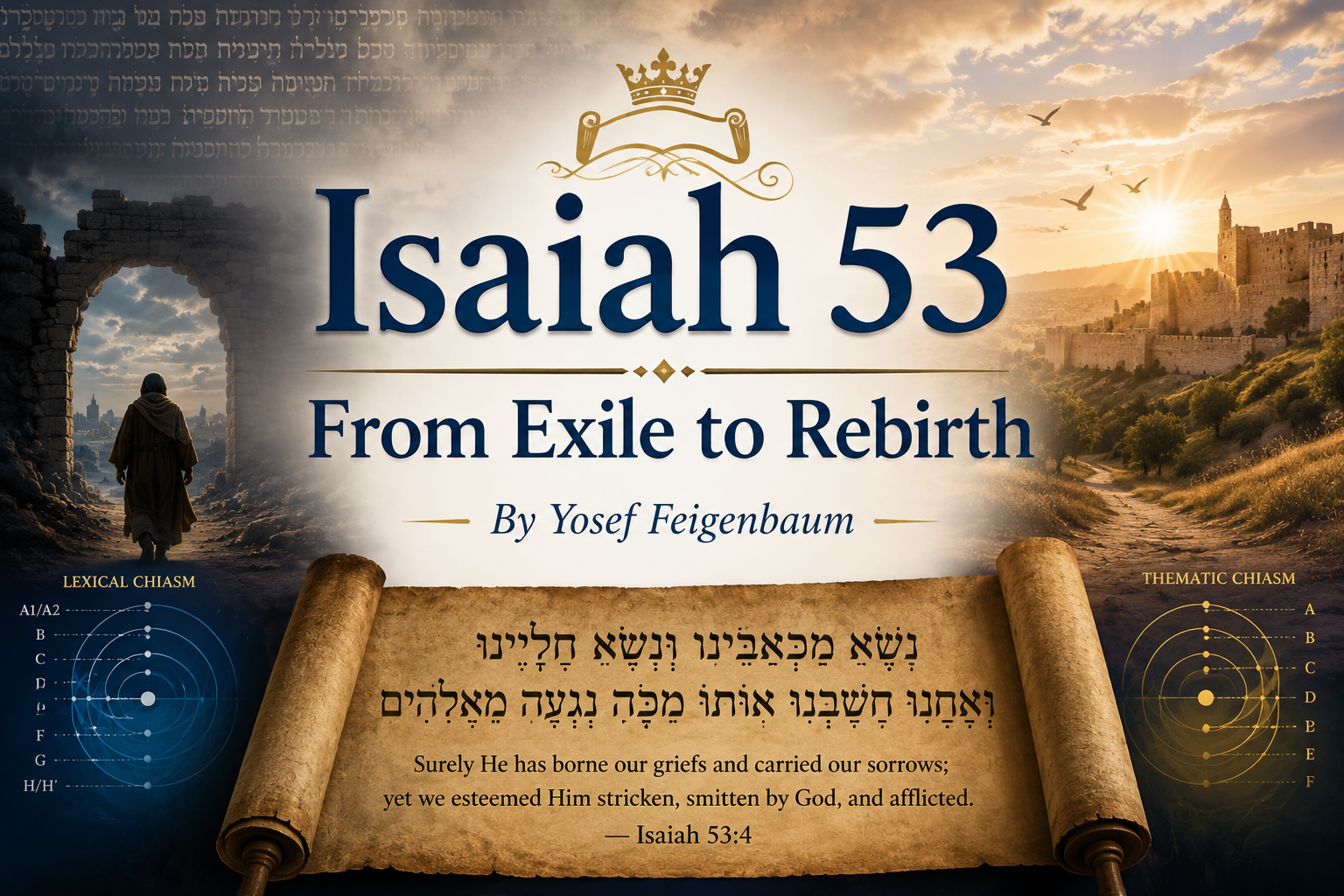
Isaiah 53 – From Exile to Rebirth
Chapter Divisions
The chapter divisions found in our modern Bibles are a relatively recent invention. They were introduced by Stephen Langton, Archbishop of Canterbury, in the early thirteenth century and subsequently adopted into Hebrew manuscripts. While the existing Biblical chapter divisions serve their purpose as a standard means of referencing texts, they are faulty at times and cannot be treated as authoritative guides to meaning — a distinction that is critically important to how people understand, and misunderstand Isaiah 53.
Isaiah 53 is part of a larger literary unit that begins at Isaiah 52:7 and ends with 54:10. These boundaries are not arbitrarily chosen. Masoretic manuscripts note Isaiah 52:7 with a crowned samech (ס) in the margin and the Great Isaiah Scroll has an upper-case omega (Ω) in the right margin at the same location. The convergence of these independent scribal marks in multiple independent textual witnesses is significant and likely not coincidental. Consistent scribal divisions at both 52:7 and 54:10 across multiple independent manuscript traditions supports the identification of Isaiah 52:7–54:10 as an accepted literary unit.
The Lexical Chiasm
Chiasms are patterns within a text where words, phrases, and ideas are repeated in a mirrored, reversed order. Multi-level chiasms are found throughout the Tanach but are most common in Isaiah and Psalms. There is broad agreement among scholars that they organize textual units and mark their boundaries — a function with direct implications for how chiastic literary units should be identified.
Isaiah 52:7–54:10 are the boundaries of an eight-level lexical chiasm. Each level exhibits a precise correspondence between a Hebrew word or root appearing in the opening of the passage and its counterpart in the closing. The cumulative weight of an eight-level lexical chiasm is compelling evidence that the passage was deliberately constructed as a single unified literary unit.
Table 1 — Lexical Chiasm in Isaiah 52:7–54:10
| Level | Hebrew Opening | Hebrew Closing | English Correspondence |
| A1/A2 | הֶהָרִים / שָׁלוֹם (52:7) | הֶהָרִים / שְׁלוֹמִי (54:10) | mountains/peace — mountains/my peace |
| B | אֱלֹ-הָיִךְ (52:7) | אֱלֹ-הָיִךְ (54:6) | thy G-d — thy G-d |
| C | פִּצְחוּ רַנְּנוּ (52:9) | פִּצְחִי רִנָּה (54:1) | break forth into joy, sing — break forth into singing |
| D | גּוֹיִם רַבִּים (52:15) | לָרַבִּים (53:11) | many nations — to the many |
| E | חֹלִי (53:3) | הֶחֱלִי (53:10) | disease — disease |
| F | נָגוּעַ (53:4) | נֶגַע (53:8) | stricken — stroke |
| G | מִפְּשָׁעֵנוּ (53:5) | מִפֶּשַׁע (53:8) | our transgressions — transgression |
| H/H’ | וְלֹא יִפְתַּח פִּיו (53:7) | וְלֹא יִפְתַּח פִּיו (53:7) | opened not his mouth — opened not his mouth (center) |
The center point of the lexical chiasm is 53:7, where the identical phrase וְלֹא יִפְתַּח פִּיו — he opened not his mouth — appears twice within the same verse. This verse is also the mathematical center of the passage — the sixteenth of thirty-one verses.
The Thematic Chiasm
Isaiah 52:7–54:10 contains a six-level thematic chiasm. Unlike a lexical chiasm which operates at the level of precise word and root matches, a thematic chiasm operates at the level of ideas, events, and images that mirror each other concentrically across the passage. The two chiasms in this passage are independent yet they converge on adjacent verses — the lexical chiasm centering on 53:7 and the thematic chiasm centering on 53:8.
Table 2 — Thematic Chiasm in Isaiah 52:7–54:10
| Level | Verses | Theme |
| A | 52:7 — 54:7,8 | Herald of salvation and ingathering — great mercy and ingathering |
| B | 52:9–12 — 54:1–3 | Joyful song, restoration of desolate Jerusalem, call to leave exile — Joyful song, restoration of Jerusalem, return of the exiles |
| C | 52:13–15 — 53:11–12 | Promise of the servant’s success and astonishment of the kings and nations — Servant’s vindication and share in the spoils with the powerful |
| D | 53:4 — 53:10–11 | The nations acknowledge and lament their punishment of the servant — G-d vindicates the servant’s righteousness before the nations |
| E | 53:7 — 53:9 | The servant went to his death in silence — The servant went to his grave in silence |
| F | 53:8 | CENTER — The nations acknowledge the injustice of the suffering they inflicted on the servant |
Verse 53:8 is the thematic center — where the nations acknowledge the injustice of the suffering they inflicted on the servant. This is the theological and moral climax toward which the entire thematic structure builds. Each surrounding thematic level points inward toward this moment — the announcement of salvation in A, the call to leave exile in B, the promise of the servant’s success in C, the nations’ acknowledgment and lamentation in D, and the servant’s silence in E all converge on the confession of the humbled nations in 53:8. From this point on the resolution progresses through the servant’s vindication, Jerusalem’s restoration, and the fulfillment of the promise of ingathering of the exiles to a rebuilt Jerusalem.
Who Are the Speakers?
One of the major problems with the conventional chapter division is the disconnection it creates between the identification of the speakers and what they say through much of Isaiah 53. The interwoven chiasms unify the passage so no such disconnect exists. The speakers of 53:1–8 — the ‘we’ who confess that they misjudged the servant — are the kings and nations introduced in 52:13–15. This is the only reasonable reading when the passage is read in its full context rather than in the fragmented version imposed by the medieval Christian chapter divisions. The shocked and speechless kings and nations of 52:15 find their voice in 53:1–8, their silence broken by confession and lamentation over their treatment of the servant.
Christian missionaries would have us believe that the speakers of Isaiah 53:1-8 are the Jewish people confessing their rejection of Jesus, rather it is the speech of the nations of the world confessing their treatment of Israel.
The Theological Implications
Vicarious Atonement
Before examining what the passage means, we must briefly address what it does not mean. Vicarious atonement is the belief that an innocent person can bear the punishment for another’s sins, thereby absolving the guilty party of their moral and spiritual debt. This is a central pillar of Christian theology: Jesus died for your sins.
The Tanach has an entirely different view: each person bears responsibility for his own sins. Ezekiel declares: “The soul that sinneth, it shall die; the son shall not bear the iniquity of the father with him, neither shall the father bear the iniquity of the son” (Ezekiel 18:20). Jeremiah states: “Every one shall die for his own iniquity” (Jeremiah 31:30). The concept of vicarious atonement is not only absent from Isaiah’s worldview — it is totally foreign to it.
The Conditions for Fulfillment
Isaiah 52:7-54:10 establishes specific conditions for its fulfillment. The outermost levels of both chiasms describe the rebuilding of Jerusalem and the return of the exiles — the national restoration of Israel. Verse 52:15 adds that the kings and nations will witness something they have been told will never happen:
For that which had not been told them shall they see, and that which they had not heard shall they perceive.
This condition cannot possibly refer to Jeremiah’s temporary 70 year exile but an extended one in which the nations have been indoctrinated with a theology that precludes a Jewish return to Jerusalem at any future time. That is exactly what was taught for two millennia to the nations of the world; replacement theology teaches that Jewish exile was permanent and divinely ordained and that the Church replaced the Jews as G-d’s chosen. Origen declared that the Jewish people “will never be restored to their former condition” (Contra Celsum, IV:22). Chrysostom insisted that “the Jews will recover neither their city nor their temple” (Adversus Judaeos, V). Augustine built his ‘doctrine of witness’ on the permanence of Jewish exile. Luther concluded that Jewish suffering was “proof that the Jews, surely rejected by G-d, are no longer his people” (On the Jews and Their Lies, 1543).
And then the impossible happened. The Jewish people, decimated after the Holocaust, reestablished Jewish sovereignty in the Land of Israel and verse 52:15 precisely describes the reactions of the nations. Winston Churchill called it “an event in world history to be viewed in the perspective of a thousand, two thousand, or even three thousand years” (House of Commons, January 26, 1949). Paul Johnson wrote: “Israel is the only one whose creation can fairly be called a miracle” (Commentary Magazine, May 1998). Rabbi Joseph B. Soloveitchik said it best:
The theological arguments of Christian theologians to the effect that the Holy One has taken away from the Community of Israel its rights to the Land of Israel… were all publicly shown to be false, baseless contentions by the establishment of the State of Israel. (Kol Dodi Dofek, Yeshiva University Press, 2006.)
The heart of the passage
Isaiah 53:2–3 — Despised and Rejected
Both verses 53:2 and 53:3 reflect the contempt and rejection of the servant by the speakers — the kings and nations. For much of the exile the Jew in Christian lands was at best an afterthought and at worst a curse, forced to live in ghettos, stripped of legal standing, subjected to expulsion and massacre. Irenaeus provided the theological justification back in the second century: “G-d has justly rejected them” (Against Heresies, 4.36.1). Seventeen centuries later, when 1,000 Jews were deported from Rome to Auschwitz, the German Ambassador to the Vatican cabled Berlin: “The Pope has not yet let himself be persuaded to make an official condemnation of the deportation of the Roman Jews.” Of those deported, only 16 survived.
Holocaust photographs of men and women reduced to skeletons, barely recognized as human beings, branded like cattle with numbers instead of names mirror Isaiah’s words of one who “had no form nor comeliness.” The nations that liberated the camps were shocked by the enormity of the sin that happened under their noses, a sin they had largely chosen to ignore, and in which they were often actively complicit.
Isaiah 53:4 — From Irenaeus to Auschwitz
In this verse the speakers perceived the servant as plagued and afflicted by divine decree — “smitten by G-d.” This was the predominant Christian perception imposed on the Jews as punishment for rejecting Jesus. The preeminent Holocaust historian Raul Hilberg reinforces this:
The missionaries of Christianity had said in effect: You have no right to live among us as Jews. The secular rulers who followed had proclaimed: You have no right to live among us. The German Nazis at last decreed: You have no right to live. (The Destruction of the European Jews, Octagon Press, 1973, p. 9.)
The road from Irenaeus to Auschwitz is clear. Isaiah 53:4 is a snapshot of the moment of terrible recognition: that what the nations called divine punishment was in fact their own horrendous crime.
Isaiah 53:5 — With His Stripes We Were Healed
In verse 5 the nations hang their heads in shame and admit that they did not merely believe they were punishing a guilty people — they believed they were healing themselves and humanity by doing so. Nazi ideology made this explicit. Hitler described Jews as a “bacillus” and “parasite” poisoning the body politic. A 1944 Nazi document declared: “Adolf Hitler brings salvation from the Jews not in a negative sense, but rather in the total return to health of our people’s body.” The Vichy government’s own preamble to the Statut des Juifs declared that Jewish influence had been “insinuating and finally decomposing” French society. Both the action and inaction of western nations stand as a bleak and stark testimony to the acceptance of an ideology that declared that the world could never be healthy as long as there were Jews living in it.
Isaiah 53:8 — The Center of the Chiasm — Punishment Without Due Process
The denial of judicial process to the Jew is one of the most consistent features of his persecution across the centuries. In medieval England Jews had no legal standing — administered under a separate court, afforded none of the protections available to ordinary Englishmen. The Inquisition, the Alhambra Decree, the pogroms of Eastern Europe, the Nuremberg Laws — in none of these did the Jewish people receive anything resembling justice.
Isaiah 53:10–11 — G-d’s Conditional Promise
Verse 10 contains a conditional — if his soul would offer itself in restitution — and promises that if the condition is met, the servant will see seed, prolong his days, and prosper. Against all historical probability, this is being fulfilled. The Jewish people, who were being murdered at a rate that threatened their extinction within living memory, today number over fifteen million. Torah is being studied in greater numbers than ever before. Israel has the highest birth rate in the developed world. Life expectancy in Israel is among the highest in the OECD.
Isaiah 53:12 — Rebirth!
For nearly two millennia Christianity has insisted that Isaiah 53 is a prophecy about Jesus. It is not. It is a prophecy about Israel — written by an Israelite prophet, addressed to the nations of the world, and fulfilled in the history of the Jewish people with a precision that no honest reader can dismiss. The servant of Isaiah 53 is Israel. The speakers are the kings and nations. All of the servant’s suffering is documented history. And the triumph — the ingathering, the restoration of sovereignty, the flourishing of the land — is unfolding before our eyes. We are living prophecy.
We were written off as history’s permanent and damned victim and we have become history’s most remarkable story of national resurrection.
Just like G-d promised.
This article is adapted from the forthcoming book An Orthodox Jewish man discovers Isaiah 53 (and a whole lot more.)