Choice vs. Claimed Divine Obligation: What Does It Mean to Live as a Noahide?
By Rod. Bryant, NETIV
“God commands me to live righteously. Consequently, I freely choose to deepen that relationship through prayer, study, charity, Psalms, meditation, community, and acts of kindness.
At first glance, this may seem like a simple statement. But within it is a profound principle that can help clarify one of the most misunderstood questions facing the Noahide movement:
How can a person in the nations develop a meaningful spiritual life without creating a new religion?
The answer can be found in an important distinction:
There is a difference between what God commands and what I freely choose as a way of drawing closer to God.
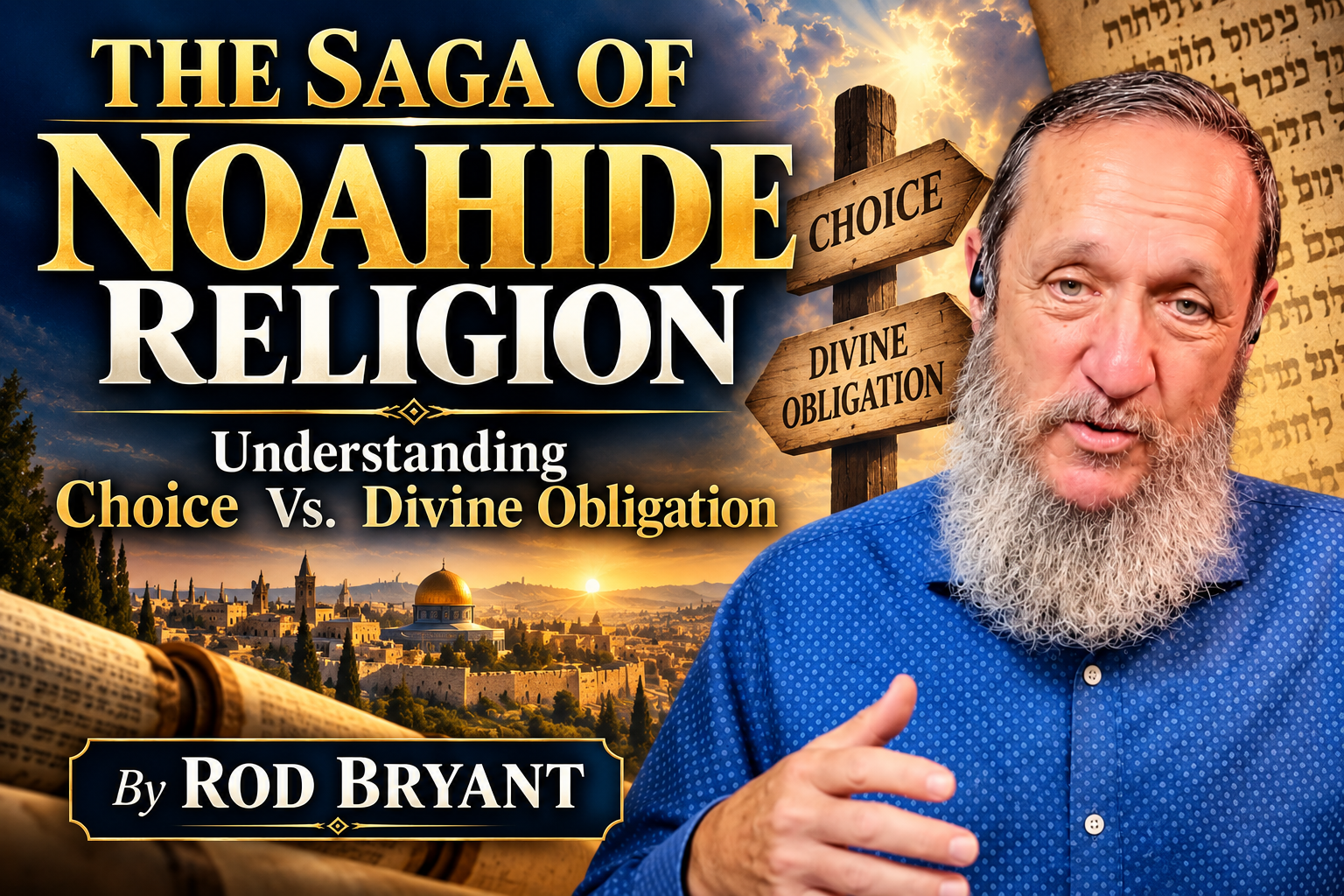
This distinction between choice and claimed divine obligation provides a practical framework for understanding Noahide spirituality.
The Problem of “Creating a New Religion”
Maimonides writes in Hilchot Melachim that a Noahide is not permitted to create a new religion or establish new commandments for himself.
For someone discovering the Noahide path, this can sound confusing.
A person may sincerely ask:
“If I believe in the One God, want to pray to Him, study His Torah, gather with other believers, raise my children in faith, practice gratitude, and develop a spiritual life—why would that be considered creating a new religion?”
The answer is that having a spiritual life is not the same thing as creating a new religion.
The problem arises when a person takes something that he has chosen to do and transforms it into something he claims God has commanded all Noahides to do.
That is the crucial distinction.
Choice and Obligation
Consider these two statements:
“I choose to pray every morning because it helps me draw closer to God.”
and:
“God commands every Noahide to pray every morning.”
The action may be identical.
The difference is the claim being made about its authority.
The first is a personal spiritual practice.
The second is a claim about divine obligation.
That distinction is at the heart of the issue.
A Noahide can have a tremendously rich spiritual life without assuming that every meaningful practice has become a commandment.
A Noahide Can Choose to Serve God
Imagine a Noahide who wakes up each morning and says:
“Master of the Universe, thank You for giving me another day. Help me use this day to live according to Your will. Help me be honest, compassionate, just, disciplined, and mindful of Your presence.”
He then reads a Psalm.
He studies Torah.
He gives charity.
He helps a neighbor.
He spends time with his family.
He meditates on God’s greatness.
He attends a Noahide study group.
He ends his day with gratitude.
None of these activities need to constitute a new religion.
Why?
Because he isn’t saying:
“God has revealed that every Noahide must perform these practices.”
He is saying:
“These are ways I have chosen to deepen my relationship with God.”
That is an entirely different proposition.
The Difference Between “I Do” and “God Commands”
Perhaps the easiest way to explain the concept is through two phrases:
“I do this.”
versus
“God commands me to do this.”
The first can describe a personal decision.
The second establishes an obligation.
That doesn’t mean that everything a person chooses is automatically acceptable. A chosen practice must still be consistent with Torah principles and cannot contradict what God has actually commanded.
But within those boundaries, there can be considerable room for personal spiritual expression.
This gives the Noahide something that is sometimes overlooked:
freedom.
Prayer Is a Good Example
A Noahide may sincerely want to pray.
He may discover that morning prayer transforms the way he approaches the day.
He may enjoy reciting Psalms.
He may develop his own personal prayers.
He may pray with his family.
He may gather with other Noahides for communal prayer.
These can all become meaningful expressions of his relationship with God.
But there is a significant difference between saying:
“We have chosen this prayer practice because it helps us serve God.”
and:
“God has commanded Noahides to follow this prayer service.”
The first is an expression of devotion.
The second is a claim of divine legislation.
The issue isn’t necessarily prayer.
The issue is the authority we assign to the practice.
Shabbat Provides Another Illustration
Consider the Sabbath.
A Noahide family might decide that Friday evening is a wonderful opportunity to slow down, have dinner together, discuss the week’s blessings, study Torah, read Psalms, and express gratitude to God.
They might say:
“Friday night has become a special time for our family to connect with God and with one another.”
That is a chosen family practice.
But if they say:
“God has commanded Noahides to observe the Jewish Sabbath and refrain from work from Friday evening until Saturday evening,”
they have made a much larger claim.
They have transformed a chosen practice into a supposed divine obligation.
That is precisely the kind of distinction that must be maintained.
What About Holidays?
The same principle applies to holidays.
A Noahide community could decide:
“We want to have an annual gathering where we celebrate God’s creation, teach our children about humanity’s responsibility to God, give charity, and renew our commitment to righteousness.”
That can be a meaningful community tradition.
But if the community declares:
“God has revealed a new Noahide holy day, and every Noahide is obligated to observe it,”
the nature of the practice has changed.
The problem isn’t gathering.
The problem isn’t celebration.
The problem isn’t gratitude.
The problem is claiming divine obligation where no divine command has been established.
This Does Not Mean “Only Seven Things Are Allowed”
One of the greatest dangers in teaching the Noahide concept is reducing it to:
“You have seven laws. Don’t do anything else.”
That is not a satisfying spiritual vision.
The Noahide commandments establish a foundation for human responsibility before God. They do not require the Noahide to live a spiritually empty life.
The Noahide can study.
The Noahide can pray.
The Noahide can contemplate.
The Noahide can give.
The Noahide can teach.
The Noahide can build communities.
The Noahide can raise children with faith.
The Noahide can pursue wisdom.
The Noahide can serve humanity.
The Noahide can develop traditions and practices that help cultivate righteousness.
The important question is not:
“Am I doing more than seven things?”
The better question is:
“Am I confusing something I have chosen with something God has commanded?”
The Noahide Life Can Be Deeply Religious Without Becoming a New Religion
This distinction allows us to imagine something very important:
a Noahide way of life.
A Noahide community could have:
- prayer gatherings
- Torah study
- Psalms
- charitable programs
- educational institutions
- children’s programs
- family gatherings
- conferences
- retreats
- meditation
- community meals
- service projects
- leadership structures
- publications
- music
- art
- cultural expressions
- traditions
None of these things necessarily constitutes a new religion.
They become problematic when the community begins presenting its own creations as new divine commandments for the nations.
This gives us an important principle:
A community can create culture without creating revelation.
That distinction may be one of the most important principles for the future development of the Noahide movement.
Don’t Confuse What Is Required With What Is Meaningful
This may be the simplest way to express the entire concept.
Something can be meaningful without being mandatory.
A practice can be holy in intention without being a commandment.
A tradition can be valuable without being Torah law.
A community custom can be beautiful without being divinely revealed.
A personal spiritual discipline can be deeply transformative without being obligatory for everyone else.
This distinction actually protects the Noahide from unnecessary religious rigidity.
It allows a person to say:
“This practice brings me closer to God.”
without having to say:
“Therefore God requires everyone else to do it.”
Three Categories for Noahide Spiritual Life
Perhaps we can think about Noahide life in three categories.
1. What God Commands
These are the obligations that come from God.
The Noahide doesn’t create these.
He receives them.
His responsibility is to understand them correctly and live by them.
2. What I Freely Choose
These are practices that help a person develop his relationship with God.
Prayer.
Study.
Psalms.
Meditation.
Charity.
Personal reflection.
Community.
Acts of kindness.
Family traditions.
Spiritual disciplines.
These can become powerful parts of a person’s life without automatically becoming commandments.
3. What God Has Forbidden
Personal choice doesn’t mean unlimited freedom.
A person cannot simply say:
“This is my spiritual practice.”
if the practice contradicts something God has prohibited.
Choice exists within the framework of divine morality.
That gives us a very useful formula:
God establishes the boundaries. Within those boundaries, the human being chooses how to cultivate his relationship with God.
Why This Is Actually Liberating
Some people hear the prohibition against creating a new religion and think:
“That means Noahides aren’t allowed to develop spiritually.”
I believe the opposite is closer to the truth.
The Noahide isn’t being told:
“You cannot approach God.”
He is being told:
“You don’t need to invent a new revelation in order to approach God.”
That is liberating.
You don’t need a new prophet.
You don’t need a new scripture.
You don’t need a new set of divine commandments.
You don’t need to recreate Judaism with a different name.
You don’t need to become Jewish in order to have a relationship with the Creator.
You can approach God within the covenantal framework given to humanity.
The Noahide Doesn’t Need to Become Jewish to Have a Relationship With God
This is one of the most important implications.
The Noahide is not an unfinished Jew.
The Noahide is not someone who must imitate Jewish life as closely as possible.
Israel has its covenant.
Humanity has its universal covenant.
The Noahide can honor and learn from Israel without pretending to become Israel.
That creates a beautiful relationship between Jewish particularity and universal human responsibility.
The goal isn’t:
“How can Noahides become more Jewish?”
The deeper question is:
“How can the nations faithfully serve the One God according to their own covenantal responsibility?”
From Commandment to Spiritual Life
This gives us a powerful model for Noahide education.
Begin with:
What has God commanded?
Then ask:
What does Torah teach us about those commandments?
Then:
How can I live these principles?
And finally:
What practices can help me internalize them?
That progression matters.
Commandment → Understanding → Application → Spiritual Practice
The mistake occurs when we reverse the process.
We shouldn’t begin with:
“What religious practices do we want?”
and then attempt to make them commandments.
Instead, we begin with what God has actually given us and ask:
“How can we build a life around it?”
A Noahide Spirituality Without Inventing a Religion
Imagine a Noahide saying:
“God commands me to live righteously. I accept that responsibility.”
Then he says:
“I choose to pray because I want to speak with God.”
“I choose to study Torah because I want to understand His will.”
“I choose to read Psalms because they help me express gratitude and awe.”
“I choose to give charity because I want to become a person of generosity.”
“I choose meditation because it helps me become more conscious of God’s presence.”
“I choose community because I cannot live a life of righteousness alone.”
“I choose acts of kindness because I want my life to reflect the goodness of the Creator.”
Notice what he has not said.
He has not said:
“God commanded me to invent these practices.”
He has said:
“God commanded me to live righteously, and I choose ways to deepen that relationship.”
That is the heart of Noahide spirituality.
Choice Does Not Make the Practice Meaningless
There is another misconception we should address.
Some people think:
“If God didn’t command me to do it, then it doesn’t really matter.”
But that isn’t necessarily true.
Love cannot always be reduced to obligation.
Gratitude cannot always be reduced to obligation.
A spontaneous act of kindness can be profoundly meaningful.
A person might give a gift to a friend because he is commanded to be charitable, but he can also develop a personal love for generosity.
A person may pray because he wants to speak with God—not merely because someone ordered him to pray.
There is something beautiful about freely choosing to respond to God.
Obligation establishes responsibility. Choice expresses relationship.
That may be one of the deepest insights in this entire discussion.
The Future of Noahide Life
If the Noahide movement is going to mature, it will need to learn this distinction.
We don’t need to create:
“Noahide Judaism.”
We need to cultivate:
“Noahide life.”
A life centered on God.
A life centered on righteousness.
A life centered on responsibility.
A life centered on human dignity.
A life centered on justice and compassion.
A life enriched through prayer, study, community, gratitude and service.
And all of this can happen without confusing our traditions with God’s commandments.
The Guiding Principle
Perhaps the entire idea can be reduced to one sentence:
God gives the commandment; I choose how deeply I will live it.
Or even more simply:
God establishes the obligation. I choose the expression.
That is the difference between divine commandment and human response.
The Noahide doesn’t need to create a new religion to draw close to God.
He needs to discover how to live faithfully before God—and then freely choose to make that relationship the center of his life.
God commands me to live righteously.
I freely choose to deepen that relationship.
That is not the absence of religion.
It is the beginning of a genuinely Noahide spiritual life.