The Noahide Congress: Why Its Importance Goes Far Beyond Religion
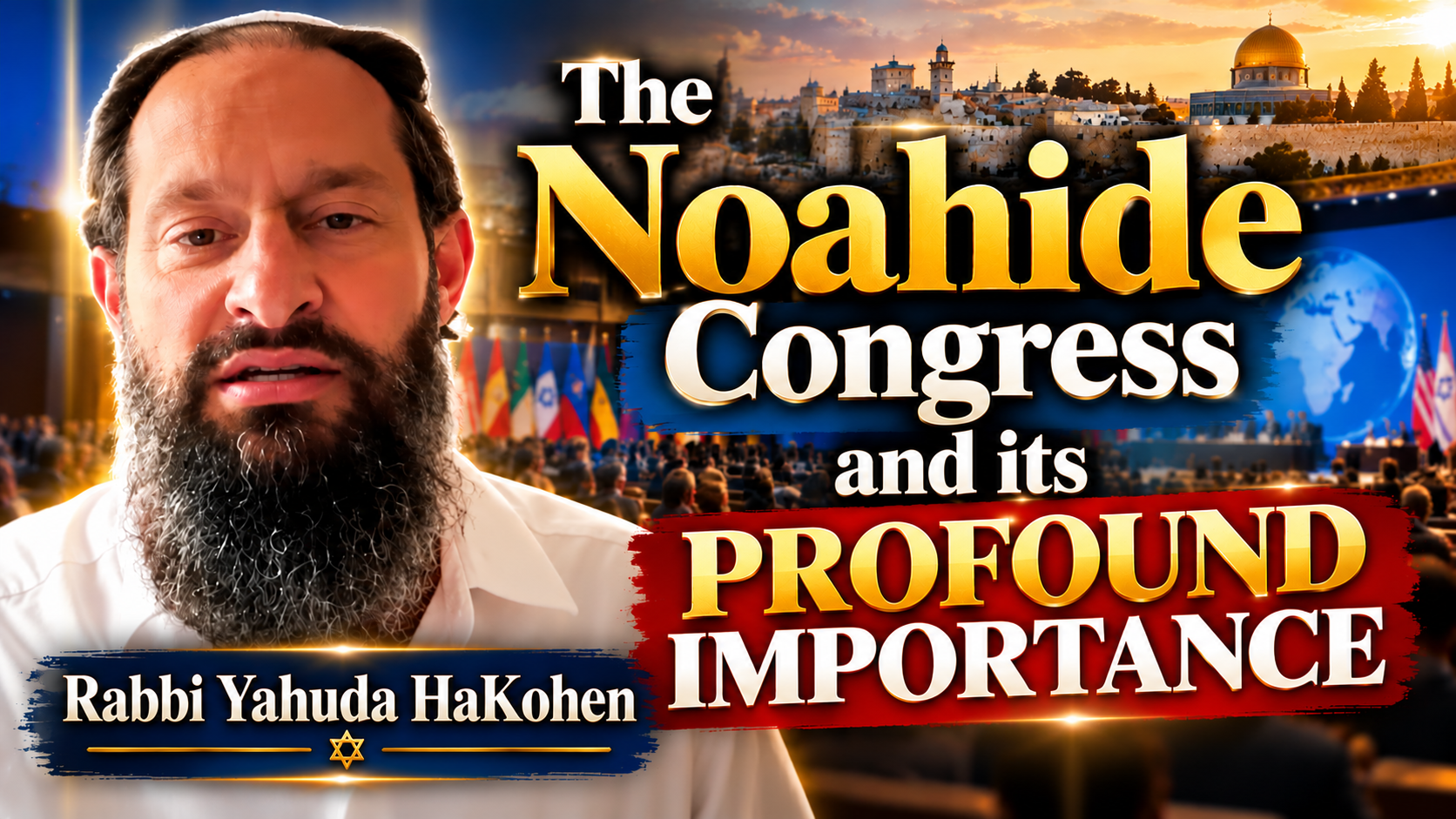
Rabbi Yahuda HaKohen on the historic opportunity before the Noahide world—and the question of how the nations can partner with Israel to help repair the world.
What if the Noahide movement represents something far greater than a growing community of people seeking to live according to the Seven Noahide Laws?
What if the moment we are living through calls for a deeper conversation about the relationship between Israel and the nations, the meaning of Jewish self-determination, and the responsibility of all humanity to build a world that reflects the will of the Creator?
These are among the questions raised by Rabbi Yahuda HaKohen, Head of Brit Olam’s English-speaking department, as he looks toward the upcoming Noahide Congress in Jerusalem.
For Rabbi HaKohen, this Congress is much more than a gathering of Noahide leaders. It represents an opportunity to explore the historical moment in which we find ourselves and to ask what comes next.
The questions are significant, the conversations are already taking place, and the implications may reach far beyond the Noahide community itself.
More Than a Gathering of Noahide Leaders
The upcoming Noahide Congress has generated considerable discussion among Noahides, Jews, and even Christians interested in the biblical foundations of the Noahide path.
Questions are emerging about the purpose of the Congress, its relationship to Jewish law (Halakha), and what Noahides are permitted or encouraged to do within the framework of Torah.
One recurring question is: What can a Noahide do according to Halakha?
These discussions matter. The Noahide path is rooted in the Torah and Jewish tradition, and questions about its practical application deserve serious consideration. Different rabbinic authorities may approach particular issues differently, and understanding those perspectives is an important part of responsible Noahide learning.
Yet Rabbi HaKohen emphasizes that the Congress is intended to address something larger than a collection of legal questions.
The deeper question is not simply what a Noahide may do, but what it means to be a Noahide in the historical moment we are living through.
How should the descendants of Noah understand their place in the world? What is the relationship between the universal responsibilities of humanity and the particular mission of the Jewish people? And how might these responsibilities work together toward a common purpose?
These questions move the conversation beyond individual religious practice and toward a broader vision of human responsibility.
Israel’s Return to Its Land: What Comes Next?
To understand the significance of the Congress, Rabbi HaKohen invites us to consider the historical transformation that has taken place through the return of the Jewish people to their ancestral homeland and the establishment of the modern State of Israel.
For thousands of years, the Jewish people lived without political sovereignty in their historic land. The modern return to Zion and the restoration of Jewish self-determination have created a new historical reality.
Whatever questions people may have about contemporary Israeli society and its political direction, one fact remains central to this discussion: the Jewish people now possess a degree of national self-determination that was unavailable to them for much of their history.
But what is the purpose of that self-determination?
Is the State of Israel simply another nation-state, concerned primarily with its own security, prosperity, and national interests? Or does the rebirth of Jewish national life also carry a deeper responsibility rooted in the biblical vision of Israel’s relationship with God and the nations?
This is not merely a political question. It is a question of identity, purpose, and destiny.
The Torah presents Israel’s calling in universal terms. In Genesis 12:3, God tells Abraham that through him, “all the families of the earth shall be blessed.” Isaiah 49:6 describes Israel’s mission in language that reaches beyond its own people:
“I will also give you as a light to the nations.”
These passages suggest that Israel’s particular identity and humanity’s universal future are not necessarily competing concerns. They may be understood as interconnected dimensions of a larger divine purpose.
Rabbi HaKohen uses a compelling image to describe this historical moment: Zionism has helped build the material vesselthrough which a greater vision can be pursued.
The physical restoration of Jewish national life has created the foundation. The next question concerns the purpose to which that foundation will be directed.
How will Israel understand its role in the world? How will its society wrestle with the relationship between national identity, Torah, and universal responsibility? And how can the nations participate constructively in this unfolding conversation?
These are questions that deserve serious attention from Jews and Noahides alike.
The Noahide Calling: From Personal Righteousness to Shared Responsibility
The Seven Noahide Laws establish a universal moral foundation for humanity. They affirm that human life is not without direction, that society requires justice, and that every human being has responsibilities before the Creator.
For many Noahides, discovering this path is a deeply personal experience. It can transform how they understand God, morality, family, community, and their place in the world.
That personal transformation is important. But is it the whole picture?
Rabbi HaKohen challenges Noahides to consider a broader question:
How do I partner with the Nation of Israel in the monumental task of repairing the world?
This question shifts the focus from identity alone to responsibility.
Being a Noahide is not simply about identifying with a particular religious movement or learning a set of rules. It also involves asking how those universal moral responsibilities can be expressed in the life of a community, the institutions of society, and humanity’s pursuit of a more just and compassionate world.
The Torah’s vision for humanity does not require every nation to become Israel. Rather, it allows us to consider how different peoples, with distinct identities and responsibilities, might contribute to a shared moral purpose.
Israel has its particular covenantal mission. The nations have their own responsibilities under the universal framework of the Noahide commandments. The challenge is to understand how these callings relate to one another without erasing the distinctions between them.
For Noahides, this means asking not only, “How should I live righteously?” but also, “How can I contribute to a world in which righteousness, justice, and recognition of the Creator become more deeply established?”
That is a much larger vision than personal spirituality alone.
It is a vision of participation.
Can Different Rabbinic Perspectives Help Us Understand Divine Truth?
One of the important subjects anticipated at the Congress is the diversity of rabbinic perspectives on Halakha and the Noahide path.
For some participants, these differences may be challenging. When one rabbi emphasizes a particular boundary and another presents a different approach, people naturally want to know which position they should follow.
These are legitimate concerns, and practical questions of Jewish law cannot be resolved simply by appealing to the value of diversity. Specific rulings require careful examination of their sources, reasoning, and applicability.
Nevertheless, the existence of differing rabbinic perspectives raises a deeper question: how should we understand the relationship between divine truth and the human effort to comprehend it?
Jewish tradition has long preserved disagreements among its sages. The Talmud records debates in which scholars reach different conclusions, examine competing arguments, and test their understanding of Torah against the reasoning of others.
The famous discussion in Eruvin 13b concerning the schools of Hillel and Shammai offers an illuminating example. Although the schools disagreed, the Talmud explains that both expressed “the words of the living God,” while the law was established according to the school of Hillel.
The passage does not mean that every contradictory practical ruling can be followed simultaneously. Rather, it illustrates that a genuine disagreement among Torah scholars can contain valuable insight even when a practical decision must ultimately be made.
This distinction is important for the Noahide world.
Diversity of thought need not automatically lead to division, suspicion, or hostility. People can recognize the seriousness of different perspectives while continuing to seek clarity about what is authoritative and applicable.
Rabbi HaKohen’s interest in bringing these conversations into the Congress points toward an opportunity for deeper learning: to explore not only what different rabbis teach, but also how they reason, what sources inform their conclusions, and what their approaches reveal about the breadth of Torah’s engagement with human life.
For Noahide leaders, this could help cultivate greater intellectual humility, more informed dialogue, and a stronger appreciation for the responsibility involved in teaching others.
The goal is not to pretend that all opinions are identical. It is to learn how to engage differences seriously without allowing them to become unnecessary barriers to cooperation.
Unity Does Not Require Uniformity
This issue has particular significance for a worldwide Noahide movement.
Noahides come from different countries, cultures, religious backgrounds, and life experiences. Some have spent decades studying Jewish sources. Others are only beginning to discover the Seven Noahide Laws. Some approach the subject through academic study, while others arrive through a personal spiritual journey.
Their circumstances and questions will not always be the same.
A healthy international movement must therefore learn how to maintain a shared foundation without demanding that every community express its commitment in precisely the same way.
The Seven Noahide Laws provide a universal framework, but applying their principles to the complexities of modern life requires education, thoughtful guidance, and responsible engagement with Jewish tradition.
Unity does not mean eliminating every difference. Nor does diversity mean abandoning common principles.
Instead, unity can emerge through a shared commitment to the Creator, respect for Torah’s authority, moral responsibility, and a willingness to work together toward common goals.
The Noahide Congress offers an opportunity to explore how this balance might be developed among leaders who serve communities across the world.
Such cooperation could strengthen not only relationships among Noahides, but also the relationship between Noahide communities and the Jewish teachers and institutions from which they seek guidance.
The future of the Noahide movement will depend, in part, on its ability to foster this kind of mature, principled cooperation.
A Vision That Extends Beyond Religion
Perhaps the most significant aspect of Rabbi HaKohen’s message is his insistence that the Congress should not be understood merely as a religious event.
Religion, faith, and spirituality matter. They shape how people understand their responsibilities and how they orient their lives toward God.
But the implications of those commitments extend into the wider world.
Justice, human dignity, honesty, responsibility, and the rejection of idolatry and violence are not concerns confined to private devotion. They influence families, communities, public institutions, and the moral character of society.
The Noahide framework speaks directly to this universal dimension of human life.
The prohibition against murder affirms the sanctity of human life. The requirement to establish courts emphasizes the necessity of justice. The prohibition against theft upholds the rights and dignity of others. The prohibition against idolatry directs humanity toward the recognition of the one Creator.
Taken together, these commandments establish a moral foundation upon which human society can be built.
The question, then, is how these principles can contribute to the repair of a world marked by conflict, injustice, and spiritual confusion.
Rabbi HaKohen describes the larger undertaking as a revolutionary project. The revolution he envisions is not simply a new religious movement or an institutional expansion. It is a change in how people understand their responsibilities within the broader story of humanity.
It asks Noahides to consider what they can contribute to the future, rather than focusing exclusively on what they may receive from a religious community.
It asks Jews and Noahides to consider how their distinct responsibilities might work together without confusing their respective roles.
And it asks all participants to think seriously about what it would mean to build societies more closely aligned with the moral vision expressed in the Torah.
The Noahide Congress and the Future of Israel and the Nations
The significance of the Noahide Congress ultimately rests in the questions it seeks to explore.
What does Israel’s return to its land mean for the future of humanity? How should the Jewish people understand their national mission in the modern world? What responsibilities belong to the nations? And how can Noahide communities participate constructively in a future shaped by universal moral principles?
These questions cannot be answered in a single conference. They require sustained study, honest dialogue, and relationships built on mutual respect.
Yet gatherings such as this can help establish the foundations for that work.
For Noahide leaders, the Congress represents an opportunity to deepen their understanding of Jewish sources, encounter different rabbinic perspectives, and consider how their communities might mature beyond a collection of individuals pursuing personal religious fulfillment.
For Jewish participants, it offers an opportunity to engage with people from the nations who are seeking to understand the Torah’s universal message and their own responsibilities within it.
For everyone involved, it presents a chance to think beyond established categories and consider what constructive partnership might look like in practice.
The prophet Zechariah describes a future in which many peoples seek the God of Israel (Zechariah 8:20–23). Isaiah envisions a world in which the nations learn God’s ways (Isaiah 2:2–4).
These prophetic visions invite reflection on a future in which the recognition of God and the pursuit of justice extend across national boundaries.
The work of bringing such a vision closer to reality requires more than enthusiasm. It requires education, responsible leadership, patience, and a willingness to translate principles into meaningful action.
That is why the conversations surrounding the Noahide Congress matter.
A Call to Participate in the Work of Repairing the World
The Noahide Congress in Jerusalem invites us to look beyond the immediate questions that often dominate religious discussions.
It asks us to consider the historical moment in which we are living and the responsibilities that may accompany it.
It challenges Noahides to see their calling not merely as a personal path of observance, but as a way of participating in humanity’s universal moral responsibility.
It invites Jews and Noahides to explore how their distinct identities and obligations can contribute to a common purpose, while respecting the differences that remain between them.
And it reminds us that building a better world requires more than agreement about ideas. It requires people willing to study, cooperate, serve, and take responsibility for the communities and societies in which they live.
As Rabbi Yahuda HaKohen anticipates engaging with Noahide leaders in Jerusalem, his message is ultimately an invitation to join a much larger conversation.
The central question is no longer simply, “What does it mean to be a Noahide?”
It is also this:
What does it mean to be a Noahide at this moment in history—and how can we work alongside the Nation of Israel to help bring a more just, God-conscious, and peaceful world into being?
That is the deeper significance of the Noahide Congress. And it is a conversation whose importance extends far beyond Jerusalem.
At NETIV, we believe that understanding the Noahide calling involves more than learning the Seven Noahide Laws. It also means exploring the responsibilities, relationships, and universal purpose that give this path its enduring significance. The conversation begins with learning—but its ultimate expression is found in how we live and what we help build together.