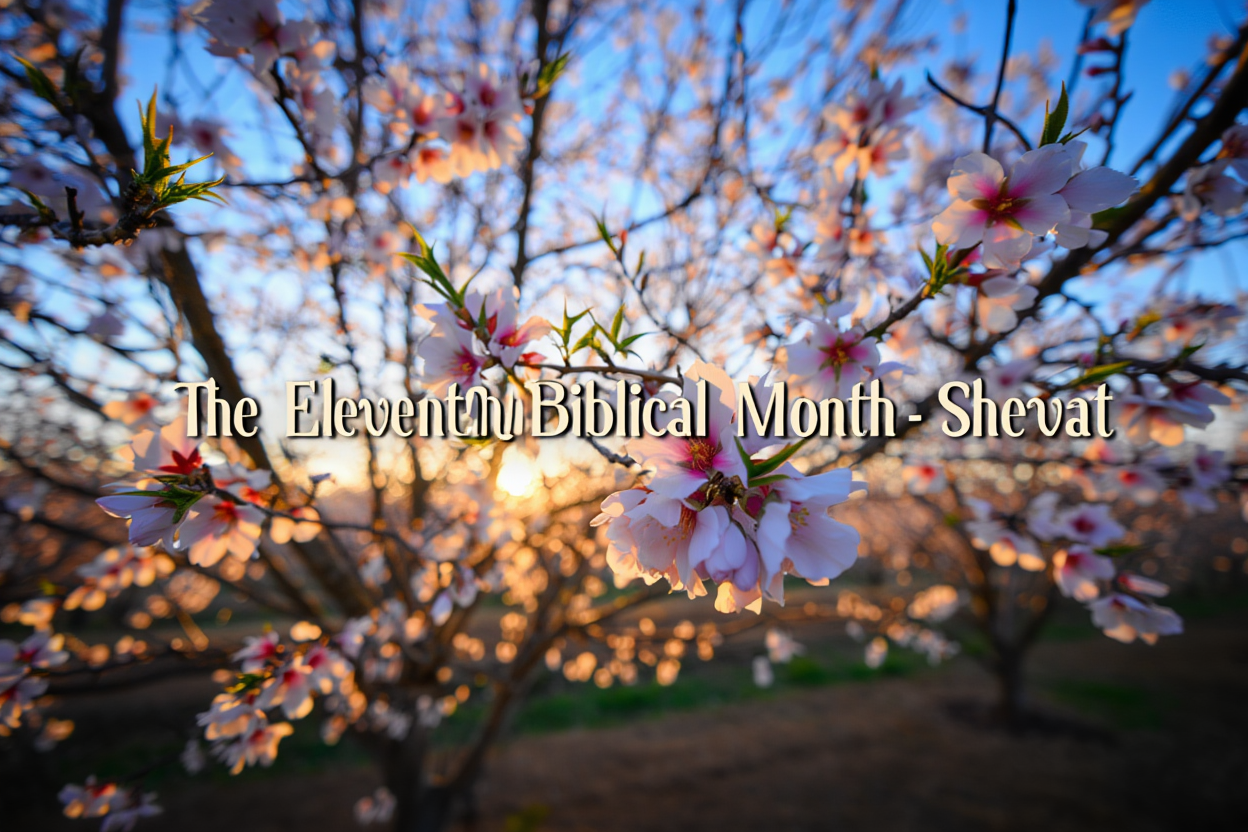
The Eleventh Biblical Month-Shevat
L’Dor v’Dor -From Generation to Generation
Tu B’Shevat-The Festival of the Trees
Part of an ongoing series entitled Hidden Sparks Beneath the Surface
By Betty Tabor Givin aka Elisheva Tavor
Shevat is the eleventh month on the Biblical calendar counting from Nisan and the fifth month of the traditional Jewish calendar counting from Tishrei. It normally falls in February or March on the Gregorian calendar
Shevat – Its Meaning, Symbolism and Background
Shevat stems from the Hebrew word shevet which means a stick, a rod, a staff, a branch, a tribe (or head of a tribe) or a symbol of authority as in a scepter. When the vast majority of us think of a rod or a staff we associate it with leadership. Moshe, the only man of whom HaShem referred to as having spoken to “face to face” comes to mind here (Exodus 33:11).
It was on the 1st day of this month of Shevat that Moshe reiterated all the words of this “Book of Torah,” to the children of Israel. Jewish tradition teaches that Moshe was born on the first day of Shevat. It was also the day that he announced he was going to die and appointed Joshua as his successor with a charge followed by a promise that He (HaShem) would go before them: “Be strong and of good courage…” (Deuteronomy 1:3; 31:1-9).
The Link Between the Generations – Passing it Down
Rabbi Jonathan Sacks, of blessed memory states that: “The most powerful link between the generations is the tale of those who came before us – a tale that becomes ours, and that we hand on as a sacred heritage to those who will come after us. We are the story we tell ourselves about ourselves, and identity begins in the story parents tell their children”.(https://www.rabbisacks.org/covenant-conversation/bo/story-we-tell/).
These stories always lead to a multitude of questions. If we go back in time to the time of Abraham, we find ourselves asking: “Why did HaShem choose Abraham and for what purpose? The answer is twofold. HaShem provides us with a clear answer: “For I know him that he will command [or teach] his children and his household” (Genesis 18:19). HaShem knew and trusted Abraham; He called him His friend, and He had no doubt that he would fulfill His G-d given role to teach his children and carry on the promise of the blessing.
So we see that the concept of shevet actually began prior to the giving of the Torah to Moshe at Mt. Sinai/Horeb. It began with one man, Abraham—who symbolically passed it down to his son Isaac and Isaac passed it to his son, Jacob, and Jacob to his sons who were representative of the 12 tribes of Israel—the 12 tribes who were to carry the shevet and pass it to their children down through the generations, l’dor v’dor. In Isaiah 41:8 we read, “But thou Israel art My servant, Yaakov whom I have chosen, the seed of Avraham My friend.”
So it was to be with the matriarchs and the patriarchs. Looking back we see clearly that their purpose was to extend this long line, this shevet…down through the lives of their children, l’dor v’dor, from generation to generation as so beautifully put forth in the Shema. They were to teach them to love HaShem their G-d “with all their hearts, all their souls, all their strength [their ‘modecha,’ their everything],”and to serve Him in all their daily activities…from the time they wake up in the morning until they go to sleep at night (Deuteronomy 6:4).
One such visual example is beautifully seen in the cherished Bar or Bat Mitzvah initiation ceremony in the synagogue when a Jewish boy or girl who has reached the age of thirteen (for a boy and twelve for a girl), and takes on the obligation of becoming a “son or daughter of the covenant.”
The Torah is taken out of the Ark and held by the rabbi who recounts how it was traditionally given by the Hand of HaShem to Moshe and Moshe to the elders, the elders to the prophets and the prophets to the Men of the Great Assembly—and so on down through the generations. He then passes it on to the grandparents and the parents who pass it to the Bar or Bat Mitzvah boy or girl. In the Orthodox and Chabad communities this ceremony is only done for the males as females do not publicly take part in leading the services.
Take a moment to picture in your mind’s eye once again the significance of that staff, that rod or shevet, which metaphorically extends down through the generations and branches out like a family tree.
From Abraham to Sinai
With that visual in your mind, think of Abraham who not only taught his children but also taught his extended family, including his servants and his entire household. The Torah points out something quite extraordinary in Parshat Lech Lecha (the Torah Portion rendering the call of Abraham). The text states that when he left Haran he took his wife, his brother-in-law and all the substance they had gathered, “and the nefesh [soul ] they had acquired in Haran”(Genesis 12:4-5). It is important to note that the singular for nefesh is used here to indicate that they were all echad, or one. They were united in purpose, under Avraham their leader.
Let’s picture the shevet again…this rod, stick, symbol of authority, this long line extending through the lives of the patriarchs and the matriarchs and down through their children to the twelve tribes of Israel from Jacob/Ya’akov. Four generations later came Moshe, who through the Hand of HaShem, led the Children of Israel out of Egypt through the wilderness to receive the Torah.
This oneness or singleness of purpose begam with Avraham and the 70 soul (singular) and was carried down and reiterated at Sinai/Horeb. It is interesting to note that when the children of Israel gathered together to receive the Torah, the text states that they encamped opposite the mountain, the singular verb for encamped, וַיִּחַן, v’yichan is used (Exodus 19:2.). Looking far into the future to the time of the final redemption, we see that this same concept of oneness is used (Malachi 3:24).
The opening verse of Parshat Nitzavim says “You stand this day, all of you, before the Lord your G-d–your heads, your tribes your tribal heads, your elders and your officials, all the men of Israel”(Deuteronomy 29:9.) The word used here for your tribes is shevteikhem. Rashi points out that this indicates the heads of your tribes” (the ones in authority who carried the shevet).
The Covenant – Sharing the Light!
The text continues as Moshe reminds the people of the covenant that HaShem made with all of them at Mt. /Horeb: “Your little ones, your wives, and your gerim [strangers] in your camp, from the hewer of your wood to the drawer of your water.” This covenant is extended even further for the text reads that it is not only with those who were standing there that day, but also includes “those not with us here today” (Verse 14).
These words make it quite clear that the ultimate purpose of the one long line portrayed by the shevet, extends from generation to generation is not solely for the Jewish people. They, with Judah in particular, are the shevatim for they hold the scepter (Genesis.49:10), but the Torah is for all humanity and its light is to be shared with the world!
“In those days it shall come to pass, that ten men out of the nations shall take hold of the skirt [tzit-tzit] of him that is a Jew, saying, we will go with you for we have heard that G-d is with you” (Zechariah 8:23).
Having been given the authority and responsibility of teaching and guarding the Torah, the Jewish people are its carriers. They are chosen for a purpose, not only to teach their children, l’dor v’dor, from generation to generation, but also to be, “a light to the nations; to open blind eyes, to bring out the prisoners from the prison, and them that sit in darkness out of the prison house” (Isaiah 41:6).
In bringing the light of Torah to the nations they are to uphold it and lift it up high like a nes (a banner), for all to see—like the Torch in the Olympic Games. They have been faithful to pass it on to their children down through the generations. Time and time again their dedication to this precious Torah has come at great cost not only to their own lives but also to the lives of their children. Has this passing down of Torah been perfect? No, there have definitely been lapses in this process. HaShem’s people have been persecuted through the ages; and consequently have often been reticent to come forth and share the ‘light of Torah.” Other times, as previously brought forth, they have been disobedient and stubborn and have gone their own way and have neglected their charge to be a “light to the nations.”
Subsequently there have been times in history when the light of Torah in the world has been reduced to only a flicker, but then then it bursts forth once again! True to HaShem’s promise, there will always remain a remnant who will carry that light! No one can argue that it is the Jewish people who have made a meticulous all-out effort to ensure the preservation of the Torah up to this day.
As a result, the message carried by the shevet, has reached many a heart of the non-Jew as well as the Jew. At times it is hidden deep within the recesses of the soul. Then, like a hidden spark beneath the surface, something ignites within our very being when that clarion call reaches us…right where we are.
The Clarion Call – The Voice From Sinai
It is a heartrending call that pierces the heart. It is going out to the four corners of the earth at this very moment… that call of HaShem to His scattered children, the call that is repeated over and over in the Torah and the Prophets: “Return to me and I will return to you”…“Gather yourselves together!” (Zechariah 1:3; 2:1). That clarion call, the Voice from Sinai/Horeb is still reverberating ‘round the globe… can you hear it?
The resulting promise of hearing and obeying that call is that the heart (singular) of the children will be turned to the fathers and the heart (singular) of the fathers to the children (Malachi 3:23-24). We will become one heart …no more animosity or jealousy between one another, between families, between the tribe of Judah and Ephraim (Isaiah 11:13) or any of the other tribes. Are you ready?
HaShem, in speaking through the prophet Ezekiel further reiterates this theme of oneness when He declares: “Behold I will take the stick of Yosaif which is in the hand of Efrayim, and the tribes of Yisrael and his companions, and will put it together, with the stick of Yehuda to form one stick and they shall be one in My hand ”(Ezekiel 37:19). One heart, one stick…that is the promise, but there is more!
“And in that day the House of HaShem will be a house of prayer for all the peoples.…” And the promise HaShem made to Avraham will come to fruition when through him, “all the families of the earth will be blessed!” (Isaiah 56:7; Genesis 12:3).
Throughout the Tanakh, we find references to nature, such as: soil, water, air light, seeds, vegetation, and trees. These aspects of nature are intricately interwoven into the celebration of the Biblical festivals and the Jewish traditions connected to them and tie in with the passing on of the shevet. Rabbi Adam Ross, contributor to Aish.com, quotes Rabbi Avigdor Miller, one of the last generation’s great rabbis: “Nature is not only there to feed us, but also to inspire us” (aish.com/tu-bshvat-three-inspiring-messages/).
Within these references to the physical components of nature that are all around us, we are given meaningful analogies that are interwoven into spiritual lessons that we can incorporate into our lives.
From the Torah and Prophets
One such analogy that ties into this concept and the final redemption is found in the words from the prophet Isaiah: “For as the days of a tree shall the days of my people be.…”they are the seed of the blessed of HaShem and their offspring with them.” This reference to seed and the subsequent blessings calls to mind the ancient promise of HaShem to Abraham —and with it the concept of DNA that binds all of HaShem’s children together which gives hope to our world! (Isaiah 65:22-23).
Deuteronomy 20:29 states that:“ A man is like a tree of the field.“ How is a man like a tree?
Jeremiah the Prophet says that the man who trusts in HaShem: “Shall be like a tree planted by the waters and spreads its roots by the river and shall not see when the heat comes for its leaves shall be green, and shall not be anxious in the year of drought, nor shall it cease from yielding fruit “(Jeremiah 17:8)
Speaking of a righteous man, the psalmist says that, “He will be like a tree planted by streams of water that brings forth its fruit in season….” (Psalms 1:2-3).
In comparison to a wicked man, the psalmist also says, “But I am like a green olive tree in the house of HaShem. I trust in the love of HaShem forever and ever. I will give Thee thanks forever…” (Psalms 52:10)
“For there is hope for a tree, if it be cut down, that it will sprout again, and that its shoots will not cease. (Job 14:7)
Trees will take part in rejoicing at the final redemption of all of HaShem’s creation!
“For ye shall go out with joy, and be led forth with peace: the mountains and the hills shall break forth before you into singing, and all the trees of the field shall clap their hands” (Isaiah 55:12; See also 1 Chronicles 16:33).
Trees and humans share basic needs…they need to be nourished in order to thrive and survive and reproduce.
- Soil – trees need to be firmly planted in soil which provides a foundation and room for roots to spread and grow. Mankind also needs to be firmly planted so as to have a strong foundation to grow its root system.
- Water -the Torah is likened to water, living water (mayim chayim). It flows down from HaShem in every generation. The lack of water results in dehydration and death for both trees and mankind.
- Air – Oxygen, breath. In creating Adam, the Torah says that He breathed into his nostrils the breath of life (nishmat chayim); related to root word for soul, (neshama). Like man, trees also mush have fresh air.
- Light – as trees thrive in sunlight which provides both life and warmth, so does man thrive in the Light of HaShem and His Torah!
The connections between mankind and nature are so overwhelmingly obvious that it is no surprise that HaShem says that He will “plant the heavens” (Isaiah 51:16) when referring to His bringing about the promised new heavens and the new earth.
Rabbi Hertz, former Chief Rabbi of Great Britain comments on this verse, “Heaven is here compared to a seed that will grow into a tree, and yield fruit and shelter to the children of men. And Heaven may be planted! Whenever we teach a child by word or example a noble thought, deed, or way of life, we plant Heaven. In the same way, Heaven can be planted in the soul of a people, or peoples. Israel was chosen and Providentially preserved, in order that through Israel God might plant Heaven i.e.–righteousness and mercy—in the soul of humanity ” (The Pentateuch and Haftorah p.836).
Jewish tradition brings us a lovely festival that highlights all these connections between nature and humanity.
Tu B’Shevat -The New Year of the Trees
Tu B’Shevat or the New Year of the Trees (: ראש השנה לאילנות, Rosh Hashanah La’Ilano tט״ו בשבט) is not one of the seven mo’edim or festivals found in Torah, but it is directly related to the times and the seasons, which are designed to teach us about connecting to our Creator and practical Torah living.
This festival gets its name from the date on which it occurs, which is the fifteenth day (tu) of the month of Shevat. It is one of four “New Years” mentioned in the Mishnah (a part of the Talmud containing a collection of the oral traditions of Jewish law), which was compiled about 200 C.E (Rosh Hashanah 1:1). It is seen as a “minor” Jewish holiday, but it has a world of meaning.
This holiday has to do with renewal, new life, and thanksgiving. marks the separation from the harvest of the previous year to the promise of spring and the new produce to come—all from the Loving Hand of our gracious Creator.
This festival normally falls in January or February. The custom is to eat fruits , but a puzzling thought arises: “Why eat fruits at this time when there are no fruits on the trees in the middle of the winter? The answer is not at all obvious. We need to go back to the festival of Sukkot to jog our memory.
In the land of Israel, the rainy season begins right after Sukkot. In Jewish tradition, a special blessing is inserted in the Amidah prayer for the winter rains to come. It takes four months, from the end of Sukkot to the 15th of Shevat, for the rains to saturate the ground. On Tu B’Shevat, the new sap begins to rise up into the trees signaling that spring is on its way. Rabbi Adam Ross states: :”The messages of Tu B’Shvat is that although the fruits have not yet grown, the process which creates them has begun!” (Ibid aish.com).
Like the trees, we too have cycles and seasons in our lives. Ross presents us with a very poignant analogy. He states: “We all have periods of winter in our lives, times of darkness, coldness, and isolation, and sometimes it’s hard to imagine ourselves back in a positive place. In Israel, after four long, cold months most trees have lost their leaves, battered by the harsh winds and frost. Just when they look ready to be cut up and used for firewood, new life appears again. The almond tree blossoms, these barren trees which have laid dormant for so long make a comeback.” The message of Tu B’Shevat he says, “is not to let the difficult non-productive times in our lives define us”
Ross also compares the cycles to the moon that waxes and wanes to the cycles of our lives, as we have suggested in previous chapters of this book CITE REFERENCE..” When this festival comes,” he says, “spring is just around the corner and as the Talmud states, better times can come ‘in the blink of an eye.’ As we witness the start of the transition from winter to spring, Tu B’Shvat teaches and builds our patience and trust that good times are ahead” (Ibid).
HaShem created nature not only to give us physical nourishment, but also to teach us practical life lessons to enhance us spiritually. Tu B’Shevat is a “wake up” call to the trees and it is a “wake up” call to us. It is another new beginning!
“On Tu B’Shvat we can look at trees and their fruit as our teachers and guides. The date palm which grows in salty conditions yet brings forth honey teaches us to extract the good from the bad. The olive tree, which produces oil, encourages us to bring more light into the world, and the grape which is crushed before producing expensive wine, teaches us the value of humility” (Ibid).
Tu B’Shevat is an environmentally focused celebration! Outside Israel it is often referred to as Jewish Arbor Day. Israelis take planting trees seriously because they realize how important the trees are for the preservation of life. According to the Temple Institute, Israel is unique in that it is the only nation in the world that has more trees in its land than it did 100 years ago.
With the exception of shemittah (Sabbatical years) people plant trees all over Israel at this time of year. Many choose to plant a tree of their own or to have one planted in memory of a departed loved one by donating $18.00, called a chai, which symbolizes the number 18 meaning life!
On Tu B’Shevat, it is traditional to partake of the seven species of Eretz Yisrael: two grains (barley and wheat), plus five fruits (olives, dates, grapes, pomegranates, and figs). We also try to taste fruits that we have not yet had the opportunity to enjoy this year. It is an opportune time to celebrate how conscious eating and enjoying the fruits of trees can be a bridge to connect us more deeply to HaShem, our Creator.
Tu B’Shevat – Learning through the Senses
As a teacher of young children, I have personally found that the best way to impart knowledge is to learn through our G-d given senses. What we see, hear, touch, taste, and do has a profound effect upon what we will remember and be able to incorporate into our daily lives. This concept is certainly not limited to the teaching of children.
According to the kabbalists, each month has a particular sense and a particular letter of the alphabet associated with it. This month has to do with the sense of taste. It is interesting to note that there are 32 teeth in the mouth, and 32 has the same numerical value as word lev or heart in Hebrew . This connects the food we eat to the heart; and the size of the heart is comparable to the size of the stomach. There is a saying that the size of your heart (which is about the size of your fist) should be the size of the meal that we eat!
Although most of us would not necessarily agree with that statement, we would agree that we do need to be mindful of the way we eat and the purpose of eating. It is for enjoyment, yes, but also for nourishment, and should be met with thanksgiving. Remember Esau? He swallowed his lentils whole.
The kabbalists also teach that within the food are Divine sparks; and as we eat and digest the food, it moves up to the brain and nourishes it— along with our entire bodies.
One of the challenges for this month according to the kabbalists, is to elevate our eating to mindful eating. As the food is converted to energy, we carry that energy into our everyday lives and give thanks to our Creator who provides so abundantly for us. In this matter, we are connecting the physical with spiritual.
The Power of a Blessing
On Tu B’Shevat, we are given the opportunity to partake of the seven species of Eretz Yisrael, 2 grains (barley and wheat), plus 5 fruits (olives, dates, grapes, pomegranates, and figs (Deuteronomy 8:8). These grains and fruits were the staple foods during biblical times and are still a very popular choice of foods in Israeli culture. We are also encouraged to taste fruits that we have not yet had the opportunity to enjoy this year during this festival. It is an opportune time to celebrate how eating and enjoying these foods can be a bridge to connect us to our Creator, and how it can bring back the blessings to Him through our thanksgiving.
We take a piece of fruit, and before enjoying it, we recite a blessing: “Blessed are you, HaShem our G-d, king of the universe, who creates the fruit of the tree.” In other words, we are acknowledging that these fruits are a gift from HaShem for our enjoyment and our nourishment. When we say the blessing for ha aitz (the fruit of the tree) and eat of it, we are using all of our senses; we are taking in the physical, and transforming a material moment to a spiritual moment. We are connecting to HaShem by an action and intent (kavanah) as we are consciously drawing in His Divine Presence (referred to as His Shechinah in Jewish tradition), into ourselves, and into our lives.
There are many meaningful customs and traditions for this holiday that vary from family to family regarding the observance of Tu B’Shevat. The important thing to remember is that however you may choose to observe this day, is that in Judaism, there is a blessing for everything: and on Tu b’Shevat, blessings abound!!!
A Personal Story and a Mnemonic
I have not been able to participate in a beautiful Kabbalistic Tu B’Shevat Seder in several years, but each year I try to partake of the seven species mentioned in the Torah with reference to the “praise of the Land of Israel!”
Several years ago after relating the story to my family about Adam and Eve’s disobedience to HaShem by eating the fruit of the one tree they were told not to partake, I posed the questions: “Why would they do such a thing? We can ask ourselves the same question: “Why do we do the things that we do today? Is it because we have free will?”
Yes, we do the things that we do because we want to—because we can, because we have a choice; and sometimes we do not make the best choices. Inevitably, after we realize that we have not made a good choice, we are remorseful and ask ourselves, why did we do what we did? The next step is to engage in t’shuvah, to ask for forgiveness. I wonder if Adam and Eve might have gone through the same process and asked themselves a similar question that might have gone something like this:
“But, Why? O Dear G-d Please Forgive!” Think of this question in reference to the seven species by using the beginning letter of each of the words in the phrase to recall the names of the seven species. Picture a plate with foods going from right to left as in Hebrew…Barley, Wheat, Olives, Dates, Grapes, Pomegranates, Figs! This mnemonic made my 12-year-old grandson laugh as he commented: “Granny, you will always be a preschool teacher!”
The sages teach that when we give a blessing to Hashem before and after partaking of His bounty, that we can turn the physical act of eating into a spiritual act of receiving. We can experience heartfelt gratitude which can nourish both body and soul; and in so doing, give ourselves a physical reminder that we are making a good choice. The Jewish sages say that in making that good choice, we are actually contributing to the rectification of Adam and Eve’s flagrant disobedience. We then are in a process of becoming a part of bringing tikkun olam (repair of our world)!
As we gaze upon the beauty of the foods represented on each of our plates, we first say the Shehecheyanu blessing over each new fruit or grain we have not yet partaken of this year. Then as we separately bless the Creator for each fruit (or grain), take each bite into our mouth and savor it, we have an opportunity to partake of the miracle which brought it into being; and we give thanks not just with our lips, but with our hearts and souls as we connect to the life-giving energy that it provides for us!
The Essential Message of Shevat
Tu B’Shevat always falls before the parsha (weekly Torah reading) Yitro where we read of the giving of the Torah. It represents the renewal of the innate desire within those of us who love HaShem to always keep our eyes, ears and our hearts open to discover those hidden sparks beneath the surface that connect the physical to the spiritual and serve to teach us how we can better serve Him.
“The Torah is a Tree of Life for all who grasp it” (Proverbs 3:18).There is a beautiful symbolism represented in this verse as we see a physical picture emerge. When one is called to the bema to read the from the Torah in the synagogue, he or she grabs hold of the wooden rollers of the Torah scroll which are appropriately referred to as aitz chayim, the Tree of Life!
As we either physically or spiritually grab hold of that aitz chayim we have the opportunity to more fully acknowledge that the message of the New Year of the Trees is a wakeup call not only for the trees, but also for us!
Life is all about connecting—connecting to the energy, the force within us, the Divine spark, the Force of all Forces, YHVH– connecting to our ancestors, to our families, l’dor v’dor, from generation to generation.
This is the essential message of the month of Shevat and the lovely celebration of Tu B’Shevat, The New Year for the Trees, which ties the physical to the spiritual in so many aspects. Let it be a “New Year” for us as well!
As we look forward to the day when we will all be ultimately connected to one another and to our Creator who gave us life, let us use this month of Shevat, a month symbolizing re-birth and renewal, to think on these things. May we continue to learn and grow and bless HaShem for His wonderful Torah; and for the opportunity to carry it forth by sharing it, and by bringing it into every aspect of our lives through living it each day—and in so doing, extend its holiness by grabbing hold of that shevet that has come down to us through the generations— for in it lie the glorious promise of the final redemption when all the hidden sparks beneath the surface will be revealed!