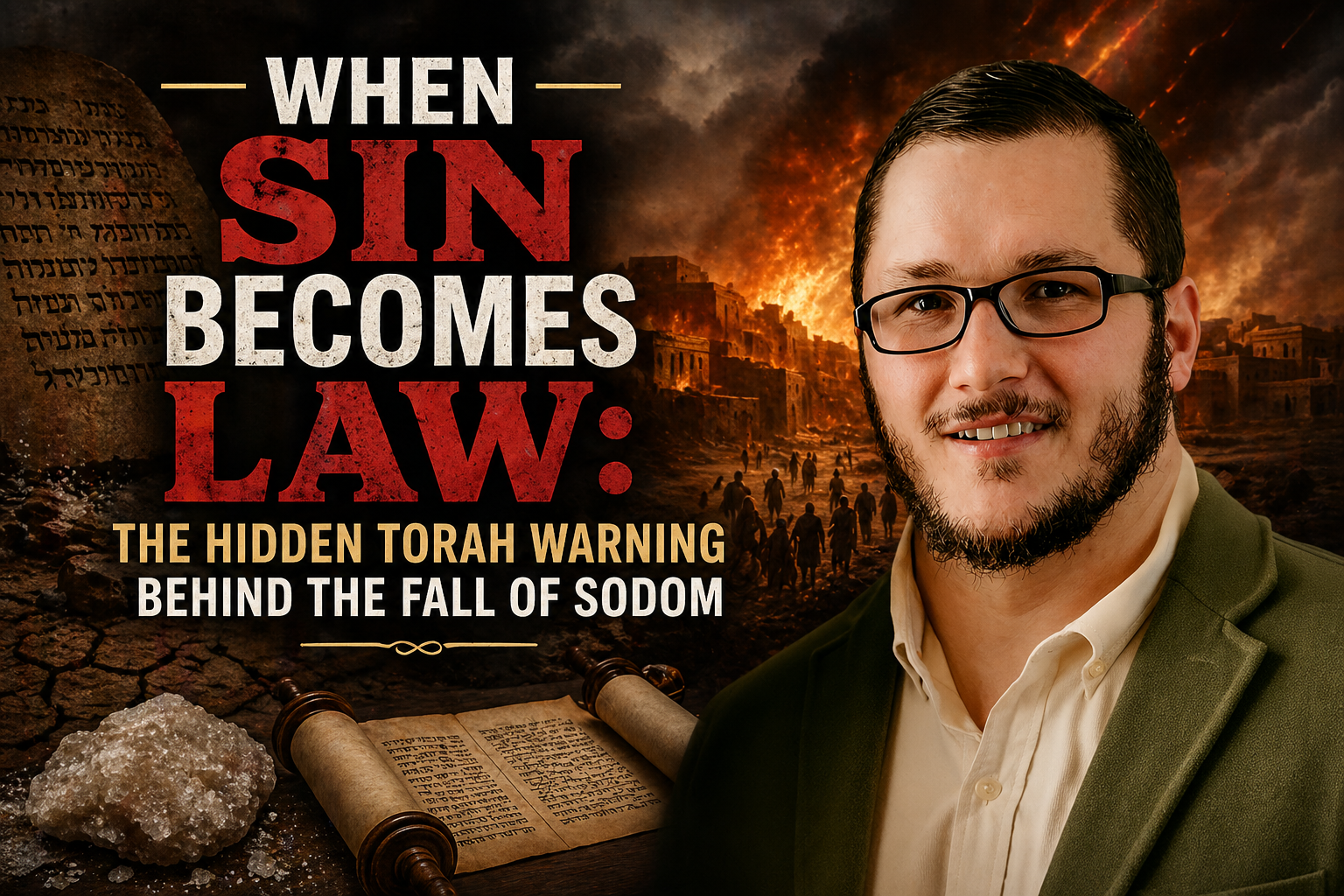
When Sin Becomes Law: The Hidden Torah Warning Behind the Fall of Sodom
By Steve Eisenhauer, The Exodus Project
The cluster of texts drawn from Genesis, later midrashic interpretation, and prophetic reflection offers a deeply layered critique of societal collapse that goes far beyond any single category of sin. When these sources are read together rather than in isolation, they present a picture of a civilization that had normalized exploitation, codified disorder, and weaponized its abundance against both the vulnerable and the outsider.
The midrash on Genesis, reflecting on the generation before the Flood, focuses on the phrase describing those who were “fair” (tovot), reading it not as a simple aesthetic note but as an entry point into systemic corruption. The interpretation that powerful men would take sexual access to women prior to their husbands, and even extend their domination toward males and animals, is not merely describing excess lust; it is describing the collapse of boundaries that make social life possible. More importantly, the tradition emphasizes that the final breaking point was not just the behavior itself, but its legalization. The idea that marriage contracts were written for such unions signals a transition from private immorality to public institution. What had once been transgressive became normalized, protected, and enforced by the very structures meant to uphold order. At that point, the society was no longer capable of self-correction.
This becomes a crucial lens for reading the events in Genesis 19. The attempted assault on Lot’s guests is often reduced in modern discussions to a question of sexual orientation, but the text itself presents something much broader and more disturbing. The entire male population of the city gathers, forming a mob intent on violent domination of outsiders. The demand “that we may know them” in this context is not about consensual relations but about humiliation, control, and the assertion of dominance over strangers. It is a form of social violence meant to degrade and expel anyone who does not belong.
Lot’s response, as troubling as it is to modern readers, underscores the severity of the situation. His offer of his daughters is not presented as morally exemplary, but as a desperate attempt to redirect a mob whose intent is clearly understood as wicked. The narrative does not pause to justify Lot; instead, it highlights the total moral inversion of the city. Even the most basic obligations of hospitality, central to ancient Near Eastern culture, have been obliterated. The guests under Lot’s roof are no longer protected by communal norms, because those norms no longer exist.
The reaction of the mob further reveals the deeper issue. They mock Lot as a “shofet,” implying that he has presumed to take on a role of authority or moral judgment within their society. This is not simply an insult; it is an ideological rejection. Lot, as an outsider, is seen as having no right to challenge the established order of the city. Their response, threatening to treat him worse than the visitors, demonstrates that dissent itself is intolerable. This is a society that not only practices injustice but actively suppresses any attempt to name it as such.
This reading is reinforced by the prophetic interpretation found in Book of Ezekiel 16:49–50. Here, the sins of Sodom are explicitly identified as pride, excess of food, and careless ease, coupled with a failure to support the poor and needy. This is not a contradiction of the Genesis account but an expansion of it. The violence and sexual aggression seen in Genesis are symptoms of a deeper condition: a society shaped by abundance without responsibility. The land is described elsewhere as fertile and well-watered, requiring little labor to sustain life. In fact, Genesis 13 describes the plain of the Jordan as “well watered everywhere… like the garden of the Lord,” evoking imagery of Eden itself. It is precisely this effortless fertility that sets the stage for moral decay. In such an environment, wealth accumulates easily, and with it comes the temptation to hoard, exclude, and dominate.
The refusal to aid the poor is not incidental; it is central. When a society possesses abundance but withholds it, it creates a moral vacuum. The vulnerable are neglected, outsiders are treated as threats, and power becomes concentrated in the hands of those who can enforce their will. The resulting culture is one of entitlement and dehumanization. In this light, the attempted assault on strangers is not an isolated act of depravity but a logical extension of a system that has already decided that some people have no inherent dignity.
The connection to the generation of the Flood, as described in midrash, becomes clearer here. In both cases, the issue is not merely that individuals sinned, but that society itself became structured around those sins. When exploitation is written into contracts, when violence becomes a communal activity, and when dissent is silenced, the culture has crossed a threshold. It is no longer a matter of reforming behavior; the entire framework has become corrupted.
The motif of judgment, then, is not arbitrary destruction but a response to a world that has rendered itself unlivable. In the Flood narrative, the earth is described as filled with violence. In the case of Sodom, the cry that rises up to heaven suggests systemic injustice so pervasive that it demands intervention. The transformation of the fertile plain into a barren wasteland is symbolically precise and thematically deliberate. The very abundance that enabled corruption is reversed. The region associated with Sodom becomes identified with salt and desolation, most notably in what is later known as the Dead Sea. Lot’s wife turning into a pillar of salt is not an isolated oddity but part of a broader symbolic pattern. Salt, in the ancient world, was not only preservative but also destructive when applied to land. In times of war, salting fields was a deliberate act to destroy fertility, ensuring that crops could no longer grow and that the land could not sustain future populations.
Seen in this light, the judgment is an explicit attack on fertility itself. The land that was once “like the garden of the Lord” is rendered incapable of producing life. The sea becomes saturated with salt, the soil becomes barren, and even a human figure, Lot’s wife, is transformed into a symbol of that sterility. This is not random devastation; it is a targeted undoing of the very conditions that allowed such a society to arise. The message is clear: a culture that abuses abundance and perverts its social order forfeits the very fertility that sustained it.
What ties these traditions together is the idea that societal collapse occurs when power, desire, and law converge in destructive ways. It is not simply that people behave badly; it is that their behavior is reinforced by institutions, justified by ideology, and protected by authority. At that point, the distinction between right and wrong is no longer meaningful within the culture itself.
The relevance of these texts in later interpretation has often been debated, especially when applied to modern contexts. It is easy to draw parallels, but such comparisons require careful thought. The ancient texts are addressing specific conditions: the abuse of power, the dehumanization of outsiders, the neglect of the vulnerable, and the codification of injustice. Any meaningful application must grapple with those themes in their fullness rather than reducing them to a single issue.
What remains striking is the consistency across sources. Whether in narrative, midrash, or prophecy, the message is clear: a society that normalizes exploitation, silences dissent, and hoards its blessings at the expense of others ultimately undermines its own foundation. The judgment depicted in these texts is not merely punitive; it is revelatory. It exposes what happens when the structures meant to sustain life are turned toward its destruction.
In that sense, the stories of the Flood and Sodom are not just accounts of past events, but enduring reflections on the conditions that lead to societal ruin. They challenge readers to consider not only individual morality but the systems and values that shape communal life, and to recognize how easily those systems can become instruments of harm when detached from justice and responsibility.