By Rod Bryant
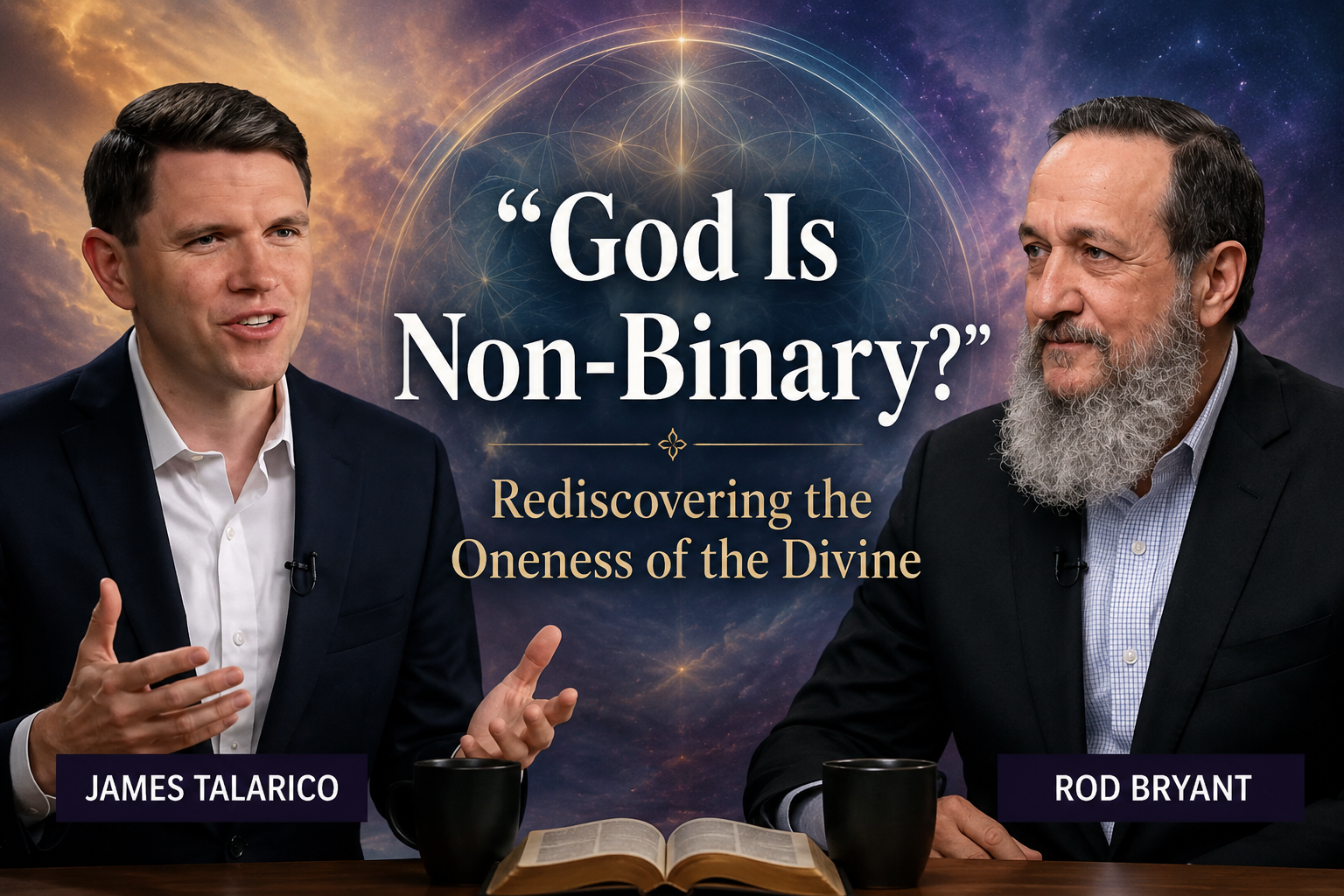
Not long ago, a Texas politician James Talarico grabbed headlines with three words: “God is non-binary.” You can probably guess what happened next. Some people erupted in outrage. Others cheered. The internet did what the internet does.
But step back from the noise for a second, and you’ll notice something. Underneath all the shouting sits a question that’s far older than any news cycle—older, in fact, than civilization itself. It’s the question humanity has been circling since the very beginning:
Who is God?
Is the Creator just a mirror—reflecting back whatever ideas happen to be fashionable this decade? Or is He something so vast that every label we reach for falls short before we even finish the sentence?
If you sit with that question through the lens of authentic Torah teaching and classical Orthodox Jewish thought, the answer that emerges is both breathtaking and deeply humbling.
Here it is, plainly: the God of Israel is not male in any biological sense. He is not female. He cannot be filed under human psychology, identity categories, or the latest philosophical framework. The Eternal One slips past every limit we know—because He is the very source from which existence itself flows.
And the words that have echoed down through Jewish history for thousands of years still hold the whole thing together:
“Hear O Israel, YHVH is our God, YHVH is One.” — Deuteronomy 6:4
One verse. And with it, every attempt to fragment, rebrand, or shrink the Divine to fit the mood of the moment simply falls apart.
The Infinite One, Beyond Our Categories
Walk through the Mishnah, the Talmud, the later mystical writings—and you’ll find the sages saying the same thing, century after century: God has no physical form. Maimonides, one of the towering minds in all of Jewish thought, put it about as bluntly as it can be put: the Creator cannot be compared to anything in creation.
Why not? Think about it. Every created thing has edges. Every created thing is, by definition, limited.
God isn’t.
And yet—here’s where it gets interesting—the Torah turns around and speaks about God in the most human language imaginable. King. Father. Judge. Shepherd. Husband. Sturdy, familiar words.
But that’s not the whole picture. Scripture also reaches for a different palette entirely: a comforting mother, a sheltering presence, a wellspring of mercy and tenderness.
Now, you might expect those two sets of images to clash. They don’t. This isn’t a contradiction—it’s a revelation. The Torah, as the sages liked to say, “speaks in the language of man,” precisely so that finite creatures like us can catch even a glimpse of the Infinite.
Elohim and YHVH — Justice and Mercy
Some of the deepest teaching in Judaism lives in the Divine Names themselves.
Take the name Elohim. It carries the weight of justice, authority, law, order, discipline. Which carries the tone of the divine masculine. This is the face of God that draws the moral boundaries and holds creation together with righteousness—the part of reality that says this far, and no further.
But the Torah unveils another Name too: the sacred four-letter Name, YHVH. And this one breathes something altogether different—mercy, compassion, lovingkindness, patience, covenant. Relationship.
Now, the crucial part. The sages never read these as two gods, or as some divided personality at war with itself. They saw them as unified attributes of one Creator—the same God, encountered from different angles.
In the language of Kabbalah, some of these attributes get described as “masculine” and others as “feminine.” But don’t take that literally. It’s metaphor, not biology. The “masculine” imagery tends to point toward transcendence, authority, structure. The “feminine” toward nurturing, compassion, receptivity, the sense of a presence that dwells within things.
Put them together and you arrive at something genuinely staggering: the Holy One holds, in perfect fullness, every quality that we humans only ever taste in fragments.
The Compassion at the Heart of Things
There’s a single Hebrew word that opens a window onto all of this: rachamim—mercy.
Trace it back to its root and you land on rechem—the word for “womb.”
That’s not a coincidence. It’s a clue.
Listen to how the prophets describe God’s compassion. They keep reaching for the language of a mother:
“As a mother comforts her child, so I will comfort you.” — Isaiah 66:13
And then this, which somehow goes even further:
“Can a woman forget her nursing child? … Even these may forget, but I will not forget you.” — Isaiah 49:15
Read those carefully. They don’t make God female. What they do is something more astonishing—they tell us His compassion runs deeper than even the fiercest human love we can imagine. The Creator is not less than a father. He is not less than a mother. He is the source of both.
The Old Temptation: Remaking God in Our Image
Every generation gets tempted by the same thing—the urge to reshape God until He matches whatever the culture happens to prize.
The ancient world built its gods in the image of power, war, sex, empire. The modern world tends to build its god in the image of politics, identity, personal ideology. Different costumes, same instinct.
But the Torah asks us to run the relationship in reverse.
We were never told to recreate God in our image. We were told to align ourselves with His truth. That’s the whole project.
Which is exactly why folding God into the vocabulary of contemporary identity—however well-meaning—ends up shrinking Him. The Eternal One won’t fit inside a slogan, a movement, or a hashtag. He stands beyond all of it. The God of Abraham, Isaac, and Jacob is infinite yet personal, transcendent yet near, just yet merciful, holy yet tender—beyond gender, and at the same time the source of every good quality that gender only partly reflects.
A Call to Rediscover the Divine
So here’s a thought worth sitting with. Maybe the real crisis of our moment isn’t confusion about gender at all. Maybe it runs deeper than that. Maybe we’re confused about God.
We’ve become a culture endlessly fluent in the language of identity—who I am, how I define myself, what I want to be called—while slowly going quiet on the older, larger question: What does it mean to stand before the Creator of heaven and earth?
The Torah keeps pointing us back to it. Our relationship with God, it insists, doesn’t rest on ideology or social trend or self-definition. It rests on humility. Reverence. Repentance. The honest pursuit of truth.
And notice the pattern: the more we lose sight of the Oneness of God, the more fragmented everything else seems to become. But the reverse holds too. When we return to the reality of Divine unity, something remarkable starts to happen. Justice and mercy find their balance. Truth and compassion stop competing and start embracing. Human dignity gets its footing back. Life recovers its weight, its sacredness, its meaning.
The answer, in the end, was never to shrink God down until He fits our categories.
The answer is to let His greatness lift us beyond them.
And maybe—now more than ever—the world needs to hear, once again, the ancient words that have carried Israel through every generation:
“YHVH is One.”
Not divided. Not redefined. Not remade in the image of man.
But eternally, absolutely, infinitely One.