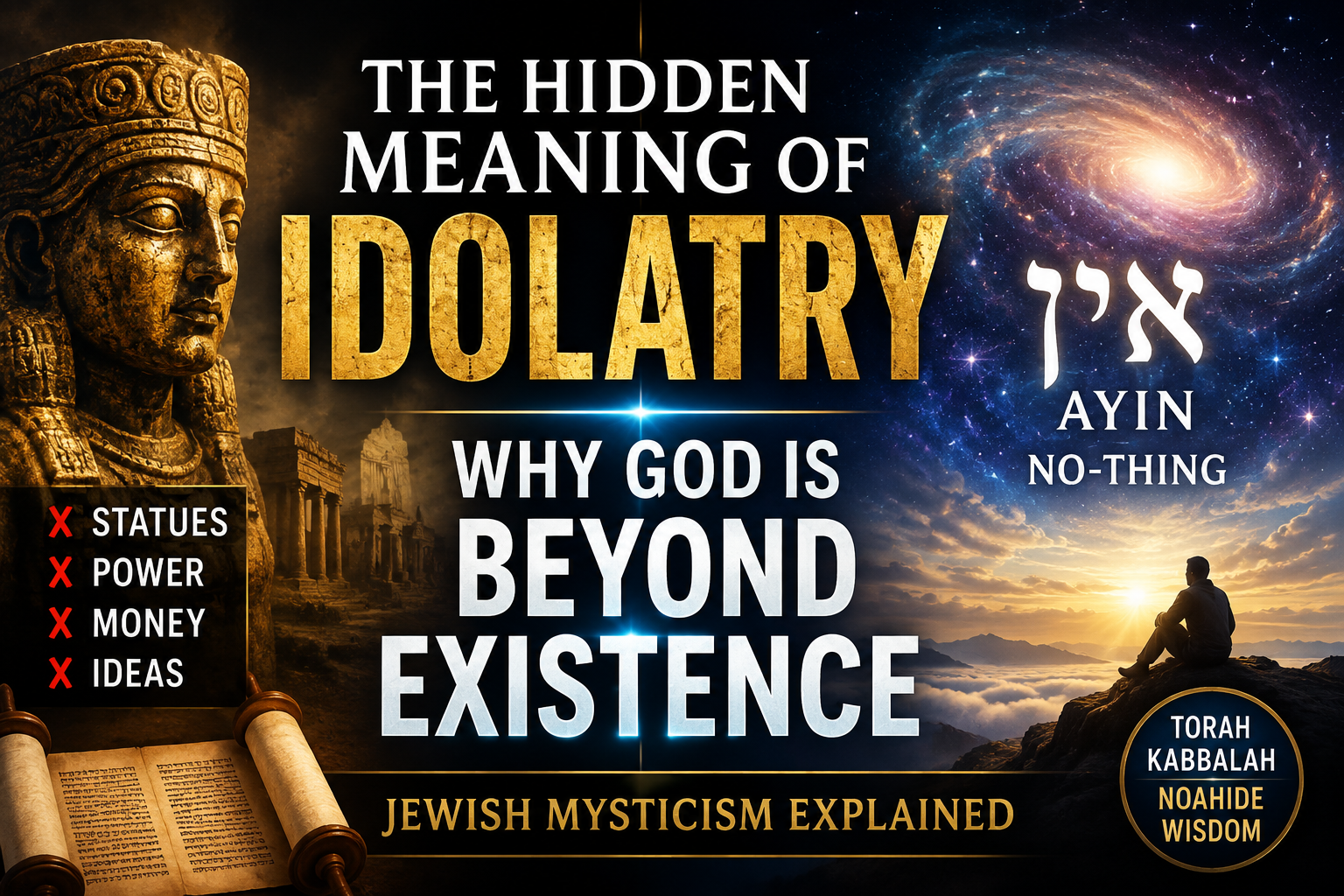
The Hidden Meaning of Idolatry: Why God Is Beyond “Existence”
By Rod Bryant, Netiv
Is Idolatry More Than the Worship of Statues?
When most people hear the word idolatry, they immediately think of ancient civilizations bowing before statues of stone, wood, or metal. Images of Egypt, Babylon, Greece, and Rome often come to mind.
While this understanding is certainly correct, the Torah may be pointing us toward something much deeper.
What if idolatry doesn’t begin with a carved image?
What if it begins the moment we reduce the Infinite God to something our finite minds can completely understand?
This question led me down a fascinating path through Jewish philosophy, Kabbalah, and the teachings of some of Judaism’s greatest thinkers. What I discovered completely transformed my understanding of God, worship, and the First Noahide Commandment.
The Question We Rarely Ask
Let’s begin with a simple question:
Does God exist?
Most people would answer immediately:
“Of course He does.”
But Jewish wisdom asks a much deeper question:
What do we mean by the word “exist”?
A tree exists.
A mountain exists.
A star exists.
You and I exist.
Everything we call “existing” shares certain characteristics. It occupies space, exists within time, possesses identifiable qualities, and can be distinguished from other things.
But what if God doesn’t “exist” in the same way that created things exist?
What if existence itself is part of creation?
If that is true, then God cannot simply be another existing thing—even if we describe Him as the greatest, most powerful, or most intelligent being imaginable.
The Torah presents a far more astonishing idea.
God is not one being among many beings.
He is the One from whom being itself flows.
Existence is not something God participates in.
Existence is something He continually gives.
Why the Kabbalists Call God “Nothing”
One of the most surprising teachings in Jewish mysticism is the concept of Ayin (אין).
The word literally means “nothing.”
At first glance, this sounds shocking.
How could the Kabbalists describe God as “nothing”?
The answer lies in understanding what they actually meant.
They weren’t saying that God doesn’t exist.
They were saying that God is No-Thing.
He isn’t a thing that can be measured.
He isn’t a thing that can be contained.
He isn’t a thing that can be fully described.
He isn’t a thing that can be placed into any category created by the human mind.
Rabbi Aryeh Kaplan often explained that Ayin should be understood as No-Thing rather than “nothing.”
Every created thing has limits.
Every created thing can be defined.
Every created thing belongs to a category.
The Infinite Creator does not.
If God could be completely understood, He would no longer be infinite.
Rav Kook and the Two Great Truths
This idea becomes even more beautiful when viewed through the teachings of Rabbi Abraham Isaac Kook.
Rav Kook believed that history has often emphasized one truth while neglecting another.
The Truth of God’s Transcendence
Traditional monotheism teaches that God is completely distinct from creation.
The prophet Isaiah asks:
“To whom then will you compare Me?” (Isaiah 40:25)
The answer is simple.
Nothing.
Nothing in creation can be compared to the Infinite One.
This protects us from idolatry.
The Truth of God’s Immanence
Yet Scripture also teaches that God’s presence fills the world.
Isaiah writes:
“The whole earth is full of His glory.” (Isaiah 6:3)
Jeremiah records God’s words:
“Do I not fill heaven and earth?” (Jeremiah 23:24)
The Zohar summarizes this beautifully:
“There is no place empty of Him.”
So which is it?
Is God beyond creation?
Or is He present within creation?
According to Rav Kook, both statements are true.
God infinitely transcends creation.
Yet His presence continually fills and sustains creation.
Pantheism vs. the Jewish View
This is where many people become confused.
Some conclude that if God is present everywhere, then everything must be God.
But Judaism rejects this conclusion.
Pantheism says:
The world is God.
Judaism says:
The world exists because God continuously gives it existence.
Those are two very different ideas.
Imagine sunlight filling a room.
Every corner is illuminated.
The room is completely filled with light.
Yet the room is not the sun.
In the same way, creation is filled with Divine vitality.
Yet God infinitely transcends creation.
Creation reveals God.
Creation is never identical with God.
The Hidden Meaning of Idolatry
This brings us to a much deeper understanding of Avodah Zarah.
Idolatry isn’t simply the worship of statues.
Idolatry begins whenever we reduce the Infinite to something finite.
An idol may be made of stone.
But it may also be:
- Wealth
- Power
- Politics
- Nature
- Technology
- Celebrity
- Philosophy
- Ideology
Or even our own mental image of God.
Every idol says the same thing:
“God is this.”
The Torah responds:
“No. God created this.”
That distinction changes everything.
The Creator can never be reduced to anything He created.
Can Theology Become an Idol?
This may be one of the most uncomfortable questions we can ask ourselves.
Can our own theology become an idol?
Maimonides certainly thought so.
He argued that even our descriptions of God have limitations.
God’s wisdom isn’t wisdom as we understand it.
God’s power isn’t power as we understand it.
Even God’s existence isn’t existence in the same way that creatures exist.
The Kabbalists make a similar argument.
The Sefirot are not God’s Essence.
They are the ways in which the Infinite reveals Himself to creation.
Confusing the revelation with the Revealer can become a subtle form of idolatry.
A Noahide Perspective
This understanding has profound implications for Noahides.
The prohibition against idolatry isn’t merely a negative commandment telling us what not to worship.
It is an invitation.
An invitation to preserve the absolute uniqueness of the Creator.
At the same time, it teaches us to recognize His presence throughout creation.
The world isn’t divine.
But it is filled with Divine purpose.
Justice becomes sacred.
Kindness becomes sacred.
Family becomes sacred.
Honest work becomes sacred.
Every moral act becomes an opportunity to reveal God’s presence in the world.
Not because these things are God.
But because they are sustained by the One who is.
The Opposite of Idolatry Is Awe
Perhaps the greatest safeguard against idolatry isn’t simply having the correct theological position.
Perhaps it is Yirah—holy awe.
The more we learn about God, the more we realize how much remains beyond our understanding.
The more we encounter His presence, the less tempted we become to reduce Him to our own ideas.
The Infinite One is closer than our own breath.
Yet He remains greater than all the galaxies combined.
He fills heaven and earth.
Yet no universe could ever contain Him.
That isn’t a contradiction.
It is the mystery at the heart of Torah.
Every idol begins with the words:
“God is this.”
The Torah begins with the words:
“In the beginning, God created the heavens and the earth.”
May we never forget the difference.
May we never exchange the Infinite for something finite.
And may we always stand before the Creator with humility, gratitude, and awe—recognizing that while His presence fills all creation, His Essence remains forever beyond our ability to define.