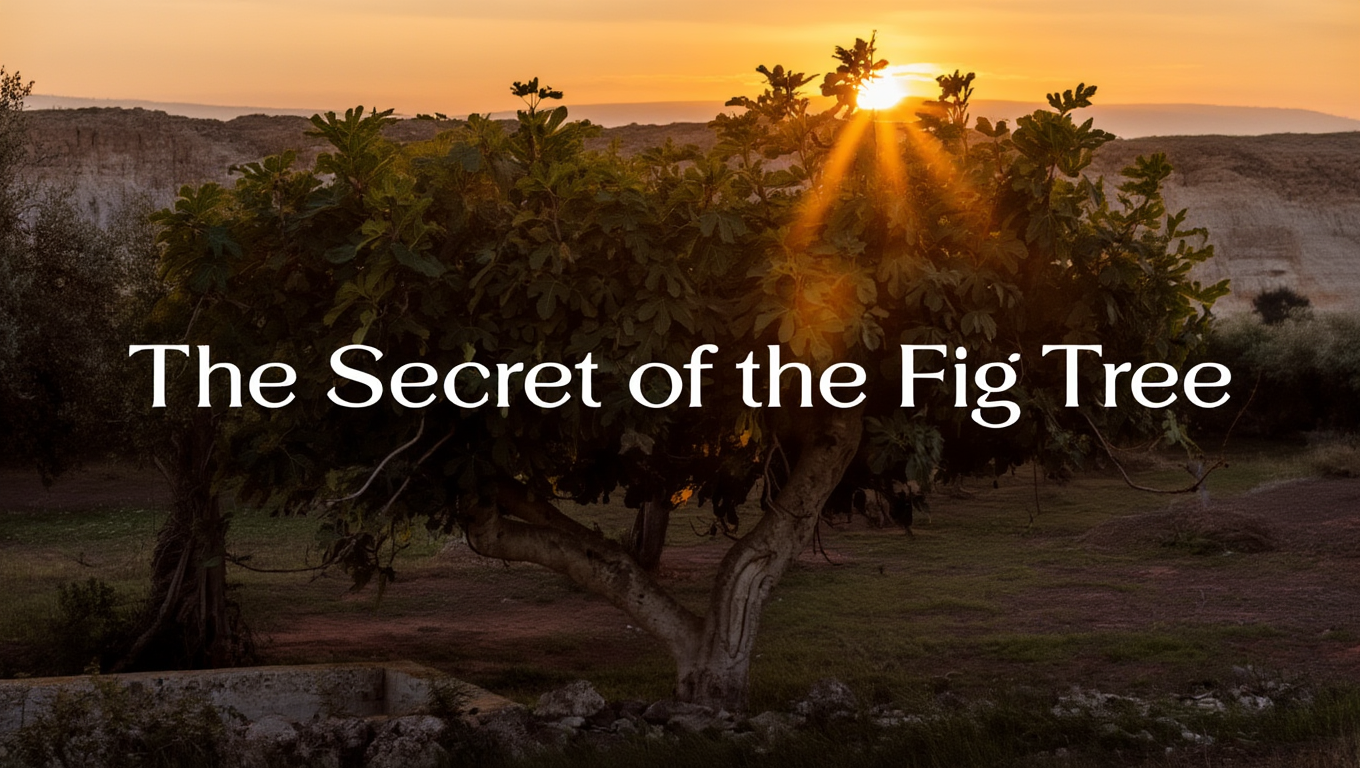
The Secret of the Fig Tree
By Steve Eisenhauer, The Exodus Project
The story of Jesus and the fig tree is almost universally misunderstood. The standard explanation claims that Jesus cursed the tree as a display of divine power or as a symbolic rebuke of Israel’s spiritual barrenness. But the text itself undermines that reading in a critical way: in the Gospel of Mark it is explicitly stated that it was not the season for figs (Mark 11:13). If the tree had no fruit and no tree should have had fruit, then the traditional interpretation makes Jesus appear irrational, even unjust, angry at a tree for behaving exactly as nature intended. That explanation is theologically hollow and literarily careless. The narrative is doing something far more deliberate.
In an agricultural society like first-century Judea, no one needed to be told when figs came into season. Everyone knew. That detail is not incidental, it is the interpretive key. By emphasizing that the fig tree was out of season, the text signals that the episode is operating symbolically, not botanically. The tree is not being evaluated as a tree. It is being read as a sign.
The placement of the story reinforces this. In the Gospel of Mark, the fig tree episode is interwoven with the temple narrative (Mark 11:11–21), forming a single literary unit. After the triumphal entry, Jesus enters Jerusalem and goes into the temple, but because it is already evening, he leaves without acting (Mark 11:11). The temple services had concluded, and there was nothing left to inspect. This detail is crucial. If the temple is the center of messianic transformation, it must be examined, but that examination is delayed until the following day.
He withdraws to Bethany (Mark 11:11), a village about two miles east of Jerusalem. This geographical movement is not incidental. According to the Book of Ezekiel, the life-giving river of the messianic age flows eastward from the temple, descending toward the Arabah and ultimately transforming the Dead Sea (Ezekiel 47:1, 8–10). Along this river grow trees whose leaves do not wither and whose fruit does not fail, bearing continuously because their life comes from the sanctuary itself (Ezekiel 47:12). The messianic age, in that vision, is marked by a disruption of natural order, fruitfulness is no longer bound to seasons, and decay is overcome.
Jesus spends the night precisely in the direction that river is supposed to flow. If the messianic age had begun, that eastern path should bear witness to it.
But it does not.
There is no river, no transformation, no evidence that the prophetic vision has taken hold in reality.
The next morning, as he returns from Bethany toward Jerusalem, he encounters the fig tree (Mark 11:12–14). The narrative setting is now fully charged. He has seen the temple but not yet inspected it. He has spent the night along the very axis of expected renewal. Now he meets a tree that, within the prophetic imagination, should reflect the abundance of the age to come.
Instead, it is barren.
It has leaves, suggesting life and promise, but it has no fruit. And again, Mark emphasizes, it is not the season for figs (Mark 11:13). This is not a failure of the tree, it is a confirmation that nothing in creation has changed. The conditions described in the book of Ezekiel are absent.
It is here that Jesus responds, and his response must be understood in light of that absence. He does not merely rebuke the tree, he withers it (Mark 11:14, 20–21). This act is immediate and destructive. In the book of Ezekiel, the trees of the messianic age are explicitly said to never wither (Ezekiel 47:12). For Jesus to wither the fig tree is therefore not just an act of judgment, it is an inversion of the prophetic expectation. It is an act of anger directed at the reality that the world still operates under the old conditions, where barrenness and decay persist.
The tree becomes a mirror, not only of Israel, but of the state of the world itself. The kingdom that was proclaimed has not manifested in the way the prophets described. Creation remains bound to its ordinary cycles. The abundance, continuity, and life envisioned in Ezekiel are nowhere to be found.
Only after this does Jesus enter the temple and act (Mark 11:15–17). And when he speaks, he frames the situation through two prophetic texts placed in deliberate tension. He cites the Book of Isaiah, declaring, “My house shall be called a house of prayer for all nations” (Isaiah 56:7), a vision of the temple as it should be in the messianic age, open, purified, and life-giving. But he juxtaposes this with the Book of Jeremiah, “But you have made it a den of thieves” (Jeremiah 7:11), a warning spoken on the eve of the first temple’s destruction.
This is not merely moral critique. It is eschatological contrast. On the one hand stands the prophetic ideal, the temple as the center of a transformed world. On the other stands the present reality, unchanged, corrupt, and under judgment.
Within this framework, the fig tree is not an isolated object lesson. It is the first confirmation of what the temple encounter will make explicit. The expected signs of the messianic age are absent. The river is not flowing eastward. The trees are not bearing perpetual fruit. The leaves are not preventing withering. The natural order remains intact.
The cursing and withering of the fig tree, then, is not an arbitrary miracle. It is a symbolic act of confrontation. It expresses anger not at the tree itself, but at what the tree reveals, that the world has not entered the age it was supposed to have entered. The act stands in direct tension with the promise of the book of Ezekiel, highlighting not fulfillment but absence.
The narrative moves, step by step, from expectation to inspection to confirmation. The triumphal entry raises the question. The evening visit to the temple delays the answer. The night in Bethany situates the test along the prophesied path of renewal. The fig tree provides the first visible result. And the temple action, framed by Isaiah and Jeremiah, delivers the final interpretation.
The distance between “a house of prayer for all nations” and “a den of thieves” is the distance between prophecy and present reality. Therefore, the fig tree stands precisely at that distance, revealing a world still waiting for the transformation it was promised and likewise confirming the same to Jesus; that he was not the messiah to usher in God’s kingdom.